
General Articles
Why Do Kamancheh Players Rotate the Instrument While They Play?
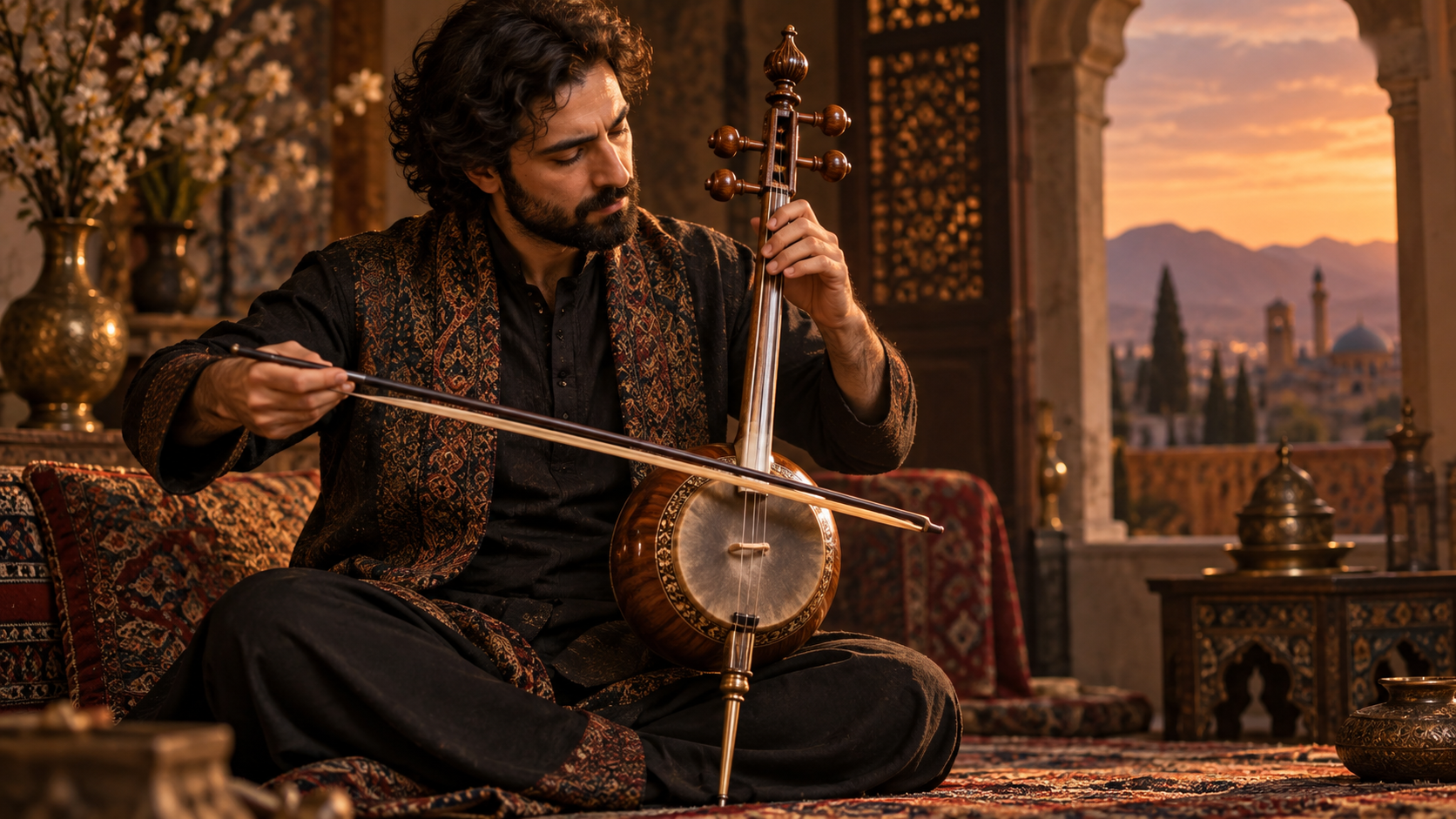
Someone watching a Kamancheh performance for the first time may notice something unusual. The musician is bowing the strings, but the instrument itself also seems to be moving. Instead of keeping the body completely stationary while moving the bow from string to string in the same way a violinist does, the player can rotate the Kamancheh on its spike so the desired string meets the bow.
This distinctive Kamancheh playing technique is closely connected to the instrument's vertical design. The Kamancheh rests on a spike at its base, giving the body the ability to pivot. This lets the musician coordinate the movement of the instrument and bow to move between strings and shape expressive melodic phrases.
The rotation is not theatrical movement. It is part of how the instrument is played.
The Kamancheh Is Held Vertically
The first clue comes from the way the instrument is positioned.
A violin is normally supported horizontally between the player's shoulder and chin.
A Kamancheh is played upright.
Its rounded resonating body sits at the bottom, while a long neck extends upward. A spike projects from the base and acts as a support point.
This spike allows the instrument to rest securely while still being able to rotate.
The body is therefore not locked into one fixed orientation.
That freedom becomes useful as soon as the bow needs to interact with different strings.
Rotation Helps Bring Each String to the Bow
On a violin, the player changes strings largely by altering the angle of the bow.
Because the strings sit across a curved bridge, raising or lowering the bow arm changes which string the bow contacts.
The Kamancheh uses different mechanics.
The player can rotate the instrument so another string moves toward the bow.
The bow still moves, of course, but the instrument itself participates in string selection.
This creates the striking visual effect of the body turning beneath the player's hand.
The movement can be subtle during a slow melodic passage or more noticeable when the musician changes strings quickly.
Why the Spike Makes This Possible
Without the spike, rotating the instrument smoothly would be far more difficult.
The spike creates a pivot point.
Imagine turning an object around a narrow axis rather than dragging its entire base across a surface.
The Kamancheh can turn while remaining vertically supported.
This design helps explain why the instrument is often described as a spike fiddle.
Many people initially focus on the rounded body or bow, but the small spike underneath performs an essential mechanical role.
Rhythm Music Shop's article on Persian traditional instruments also discusses the Kamancheh as one of the instruments that helped shape Iranian music.
The Bow Is Different From a Violin Bow
Although the Kamancheh and violin are both bowed string instruments, their playing systems should not be treated as identical.
Traditional Kamancheh technique involves a bow with horsehair whose tension can be influenced by the player's hand.
The musician can interact with the hair in ways that differ from the fixed tension of a standard modern violin bow.
That control works together with the movement of the instrument.
The result is a playing system in which the bow hand and instrument hand are continually cooperating.
The body rotates, the bow travels, and the player's fingers determine the pitch on the strings.
Rotation Allows Efficient String Changes
Fast music requires efficient movement.
If the musician had to make a large bow-arm adjustment every time a neighbouring string was needed, passages could become physically awkward.
Rotating the instrument reduces some of that movement.
A small turn can change the relationship between string and bow.
The musician learns exactly how much rotation is required.
Beginners may initially rotate too far or not enough, causing the bow to touch the wrong string.
With practice, the movement becomes automatic.
The player begins thinking about the melody rather than consciously calculating the angle of the instrument.
It Also Influences Expression
The purpose of rotation is not limited to reaching the correct string.
Bow angle, pressure, speed, and contact all affect tone.
By coordinating the rotation of the Kamancheh with the bow, an experienced musician can maintain controlled contact throughout a phrase.
This matters because the instrument is known for a highly expressive, almost vocal quality.
The Kamancheh can sustain notes in a way plucked instruments cannot.
A player can begin quietly, increase intensity, soften again, add ornamentation, and connect notes into long melodic lines.
The mechanical freedom of the instrument supports that expressive style.
The Rounded Body Encourages the Motion
The Kamancheh's body is typically rounded rather than shaped like a violin.
That geometry works naturally with rotation.
Because the instrument is being supported at the spike, turning the body does not require the player to reposition the entire instrument.
The motion can remain centred around the same basic axis.
This is one of those cases where an instrument's visual design and playing technique are directly related.
The Kamancheh looks the way it does partly because its components belong to a specific method of producing sound.
Rotation and Left-Hand Fingering Happen Together
While the instrument rotates, the left hand still has another major responsibility.
It must locate the pitches along the strings.
Unlike the fretted Tar and Setar, the Kamancheh requires the musician to control pitch without tied frets providing fixed stopping points.
The ear is therefore essential.
The player must coordinate accurate fingering with bowing and rotation at the same time.
That may sound complicated, and for beginners it certainly takes practice.
Eventually, these movements become interconnected.
The musician hears the next note, places the finger, turns the instrument as required, and moves the bow in one coordinated action.
Why the Instrument Can Sound So Much Like a Voice
The Kamancheh is frequently described as vocal in character.
Part of that impression comes from sustained bowing.
A plucked string begins strongly and then naturally decays.
A bowed string can continue sounding as long as the bow keeps supplying energy.
This makes it possible to shape notes over time.
Combined with pitch slides, ornamentation, dynamic changes, and the flexibility of a fretless fingerboard, the instrument can produce phrases that resemble vocal expression.
The Kamancheh's role in Iranian music has therefore become closely associated with emotional melodic performance.
It can lead, respond, sustain, and ornament phrases with a degree of flexibility that suits Persian classical repertoire extremely well.
Is the Player Constantly Spinning the Kamancheh?
Not exactly.
Rotation should not be imagined as dramatic spinning.
Most of the movement is controlled and functional.
The player turns the instrument enough to create the desired relationship between the selected string and bow.
During some passages, very little visible movement may occur.
During others, changes between strings make the rotation easier to see.
Experienced musicians generally make the motion look effortless because they are not exaggerating it.
It becomes part of normal playing posture.
Why Violin Technique Cannot Simply Be Copied
A violinist learning Kamancheh already understands many important concepts such as bow control, intonation, string crossings, and sustained tone.
However, the physical technique still requires adjustment.
The instrument is held differently.
The bow is handled differently.
The relationship between the player's body, bow, and strings changes.
Most importantly, the Kamancheh itself can rotate as part of string selection.
A violinist who tries to keep the instrument completely motionless may make the process harder than necessary.
Learning the instrument means learning its own mechanics rather than forcing another instrument's technique onto it.
The Design Reflects the Music It Performs
Like many traditional Persian instruments, the Kamancheh shows how construction and repertoire influence one another.
The spike provides a pivot.
The body supports resonance.
The bow sustains the strings.
The fretless neck permits continuous control over intonation.
The rotating technique helps the performer navigate between strings.
Together, these features create an instrument capable of performing the ornamented, expressive melodic language found throughout Persian music.
No single feature explains the Kamancheh's sound.
Its identity comes from the entire system working together.
The Movement Is Part of the Instrument's Character
The next time you watch a Kamancheh player perform, pay attention to the relationship between bow and body.
The instrument is not simply being held while the bow does all the work.
The Kamancheh participates physically in the motion.
Its spike allows it to pivot, and the musician uses that ability to bring different strings into position while maintaining bow control.
That distinctive Kamancheh playing technique is one reason the instrument looks so different in performance from a violin, even though both produce sound through bowed strings.
It is also an excellent example of how centuries of instrument design can lead to playing techniques that are both practical and visually distinctive.
If you are interested in Kamancheh or other Persian musical instruments, visit Rhythm Music Shop in Markham. We carry traditional instruments, strings, accessories, and Persian music books for beginners and experienced players. Contact us if you need help choosing an instrument or finding appropriate learning materials.