
General Articles
What Makes Some Tar and Setar Instruments So Expensive?
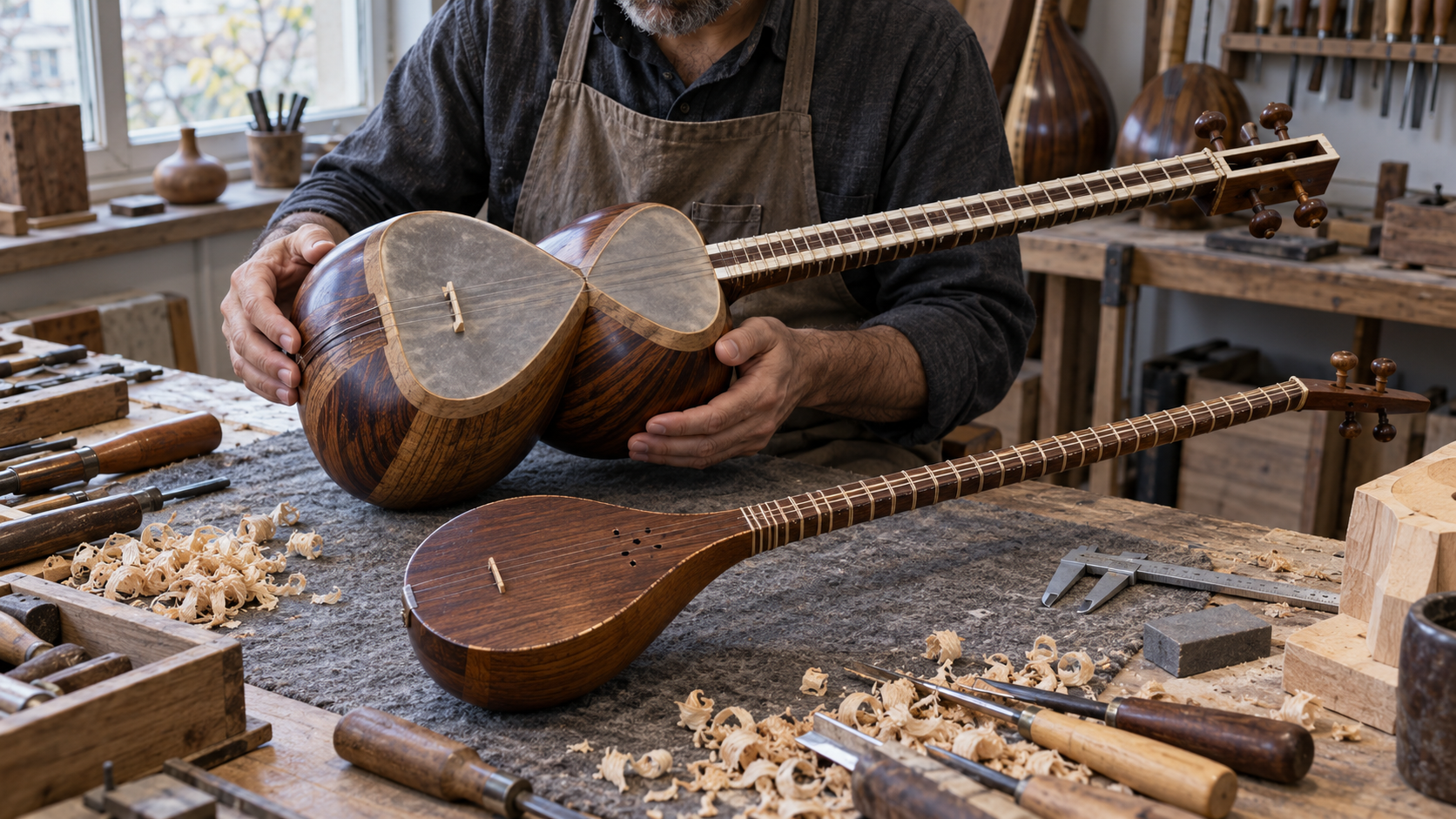
Place two Persian Setars beside each other, and they might appear remarkably similar. Both may have a mulberry wood body, a walnut neck, traditional tied frets, and four strings. Yet one might be intended for a beginner, while the other commands a significantly higher price.
The same differences can be found when comparing Persian Tar instruments.
Understanding Tar and Setar prices requires looking beyond appearance and basic material descriptions. The experience of the instrument maker, precision of construction, acoustic performance, playability, and amount of individual labour can all influence what an instrument costs.
However, a higher price does not automatically guarantee a better instrument for every musician.
Knowing what contributes to the cost can help buyers distinguish genuine craftsmanship from features that add little practical value.
Why Can Two Similar Instruments Have Different Prices?
The price of a traditional Persian instrument reflects several overlapping factors.
Some relate directly to manufacturing expenses, such as labour, materials, and the complexity of construction.
Others are connected to reputation, scarcity, and the demand for instruments made by particular craftsmen.
Two Setars may both be described as having a mulberry wood bowl and walnut neck, but those descriptions reveal very little about how accurately the instruments were assembled or how they respond when played.
One might have carefully shaped components, consistent fret positioning, and a balanced tonal response.
The other might require considerable adjustment before it feels comfortable or produces clear notes.
This distinction becomes especially important when comparing handcrafted Persian instruments and their craftsmanship, where the quality of individual construction decisions can matter as much as the materials themselves.
Price Is Not a Direct Measurement of Sound Quality
An instrument's price can provide some information about its market position, but it cannot independently establish acoustic quality.
A beautifully decorated Setar might cost more because of elaborate workmanship, even if a less expensive instrument performs equally well.
Similarly, a famous maker's name can increase demand without guaranteeing that every instrument will suit every musician.
Personal preference also matters.
One performer might favour a particularly bright, responsive Tar, while another prefers an instrument with a softer response.
An expensive instrument is only worth its price to a particular musician if its qualities justify the additional cost.
The Importance of Wood Selection
Wood is one of the most recognizable materials used in traditional Persian instrument construction.
Persian Tar bodies are commonly carved from mulberry wood, while Setar bowls may be made from mulberry or other suitable woods depending on the maker and design.
Walnut is frequently used for necks and other structural components.
However, simply using these woods does not guarantee a premium instrument.
Wood Quality and Stability
Even pieces of timber from the same tree can have different characteristics.
Grain direction, density, moisture content, structural defects, and the way the wood was dried all influence its suitability for instrument construction.
Instrument makers must consider whether a particular piece can be carved or shaped without compromising stability.
Wood that has not been dried appropriately may change shape as it responds to environmental conditions.
This can affect joints, neck alignment, or other important components.
Carefully selected and properly prepared timber can therefore increase the cost of construction.
However, claims that older wood always sounds better should be treated cautiously.
An instrument's performance depends on the finished structure, not merely how long its materials were stored.
Does Rare Wood Automatically Make an Instrument Better?
No.
Unusual grain patterns and rare materials may increase an instrument's price, particularly when they are difficult to obtain.
Yet visual rarity is not the same as acoustic superiority.
A well-made instrument constructed from ordinary, suitable wood can perform better than one built from expensive material that was poorly selected or shaped.
The important question is whether the maker has used the material effectively.
For musicians interested in the relationship between construction and sound, how instrument craftsmanship affects sound quality provides useful context.
Hand-Carved Construction and Labour Costs
Traditional Persian instruments can require substantial manual labour.
The amount of work involved depends on the instrument, construction method, and level of finishing.
Some components may be produced using specialized machinery, while others require careful individual shaping and adjustment.
For highly experienced instrument makers, much of the value lies in knowing exactly where and how to make those adjustments.
Why Tar Construction Is Particularly Demanding
The Persian Tar features a distinctive double-bowl wooden body with a stretched membrane covering its openings.
Creating the body requires careful carving.
The maker must establish the instrument's shape while controlling the thickness and structural integrity of its walls.
Uneven carving can affect strength and acoustic behaviour.
After the wooden body is prepared, the membrane must be fitted and tensioned.
The bridge, neck, frets, strings, and tuning components must then function together.
Each stage involves decisions that influence the finished instrument.
The process behind how Persian Tar makers build their instruments demonstrates why individually produced instruments can require so much skilled work.
Setar Construction Requires Different Precision
A Setar generally has a smaller, pear-shaped resonating body and a long, narrow neck.
Its bowl may be carved from a single piece of wood or assembled from separate wooden ribs, depending on the construction style.
Both methods require accuracy.
The neck must be properly aligned, the soundboard must respond efficiently, and the tied frets need to be positioned appropriately.
Because the Setar is played with relatively delicate finger movements, small inconsistencies in string height or fret placement can become noticeable.
A carefully constructed Setar allows the musician to produce clear notes without unnecessary physical effort.
That responsiveness can justify paying more for an instrument that has received additional individual attention.
The Skill and Reputation of the Instrument Maker
The person who makes an instrument can significantly influence its price.
Experienced craftsmen often spend many years developing their understanding of wood behaviour, structural design, acoustics, and the practical needs of musicians.
Their work may also develop a recognizable tonal character or construction style.
What Does a Master Instrument Maker Contribute?
Experienced makers do more than reproduce a familiar instrument shape.
They make judgments throughout the construction process.
These decisions may involve:
-
Selecting appropriate wood for different components.
-
Determining body dimensions and wall thicknesses.
-
Shaping the neck for comfortable playing.
-
Preparing and fitting a Tar membrane.
-
Positioning the bridge.
-
Adjusting string height and spacing.
-
Evaluating resonance and tonal balance.
-
Correcting imperfections before the instrument is completed.
A skilled maker may identify problems that are difficult for an inexperienced builder to recognize.
The accumulated knowledge behind these decisions contributes to the value of handmade instruments.
Does a Famous Maker's Name Justify a Higher Price?
Sometimes, but not always.
An established reputation may reflect years of consistently producing instruments valued by professional musicians.
Demand for a particular maker's work can also exceed the number of instruments available.
This may increase prices independently of production costs.
For example, Rhythm Music Shop carries instruments associated with recognized makers, including models such as the Setar by Master Masoud in Kamalian style.
Comparing instruments from different makers can help buyers understand variations in design, materials, and intended playing level.
Nevertheless, the maker's name should be one consideration among several.
An instrument should still be evaluated for sound, comfort, construction quality, and condition.
How Sound Quality Influences Instrument Value
One of the most important reasons musicians invest in higher-quality instruments is their acoustic response.
However, descriptions such as warm, bright, powerful, or rich are not precise measurements of quality.
They describe tonal characteristics that may be desirable in different musical contexts.
A useful evaluation considers how consistently the instrument responds across its playing range.
Resonance and Sustain
Resonance describes how an instrument responds to vibration.
Sustain refers to how long a sound continues after it is produced.
Both can influence a musician's experience, but longer sustain is not always better.
Some passages benefit from notes that continue ringing.
Others require clarity and separation between successive notes.
For Persian music, a balanced response can be especially important because melodies often include rapid ornaments alongside sustained tones.
A well-matched instrument allows the performer to control these differences.
Dynamic Responsiveness
An instrument should respond predictably when the musician changes playing intensity.
For example, a Tar should allow a player to move between gentle plucking and stronger accents without losing unnecessary clarity.
A Setar should produce a usable tone with delicate finger movements.
An instrument that requires excessive force to produce a clear sound may make advanced techniques more difficult.
Consistency Across Notes
An expensive instrument should not be judged solely by how impressive one open string sounds.
Musicians should also listen for differences between notes played along the neck.
Potential problems include:
-
Certain notes sounding unusually weak.
-
Excessive buzzing.
-
Unwanted rattling.
-
Inconsistent tonal response.
-
Difficulty maintaining accurate intonation.
These issues are not necessarily proof of poor construction.
Some can result from an unsuitable setup or deteriorating strings.
Understanding how instrument setup affects sound quality can help buyers distinguish a correctable issue from a more fundamental limitation.
The Role of the Tar's Skin Membrane
The Tar has an important construction feature that distinguishes it from the Setar.
Rather than relying entirely on a wooden soundboard, the Tar uses a stretched membrane.
String vibrations pass through the bridge into this membrane, which contributes significantly to the instrument's acoustic response.
Why Membrane Preparation Matters
The type, thickness, condition, and tension of the membrane can affect the Tar's sound.
A membrane that is poorly fitted may respond unevenly.
The maker must consider how the membrane works with the bridge, strings, and carved wooden body.
Preparing and fitting these components requires practical experience.
This additional work contributes to the production cost of a Tar.
The acoustic reasoning behind why the Persian Tar uses a skin soundboard helps explain why seemingly small construction differences can have noticeable musical consequences.
Decorative Workmanship Versus Musical Performance
Some traditional Persian instruments feature elaborate decorative elements.
These might include detailed wood carving, inlays, engraved tuning pegs, ornamental binding, or carefully finished surfaces.
Decorative workmanship can require significant time and skill.
It may also make an instrument especially attractive to collectors.
However, decoration should be evaluated separately from acoustic performance.
When Decoration Adds Value
An instrument with detailed handmade ornamentation may cost more because it requires additional specialized labour.
The design might also reflect a particular regional tradition or the artistic style of its maker.
For collectors, these characteristics can form an important part of the instrument's value.
When Decoration Does Not Improve Sound
An elaborate inlay does not automatically produce better resonance.
Likewise, a beautifully polished surface cannot compensate for poor neck alignment or inaccurate fret positioning.
Musicians primarily interested in performance should give greater importance to sound, comfort, and structural quality.
Collectors may reasonably place greater value on appearance, craftsmanship, and historical significance.
Neither approach is inherently wrong, but the buyer should understand what they are paying for.
Why Some Handmade Instruments Are More Expensive Than Factory-Made Models
Mass production and individual craftsmanship operate under different economic conditions.
A workshop producing large numbers of similar instruments may use standardized dimensions, repeated processes, and specialized equipment.
These methods can reduce the labour required for each instrument.
A maker producing instruments individually may spend considerably more time selecting materials, shaping components, and evaluating the finished result.
That additional work can increase the selling price.
However, it would be inaccurate to assume that every handmade instrument outperforms every factory-made model.
Modern manufacturing can produce consistent, dependable instruments.
Likewise, handmade construction varies in quality depending on the maker's experience and standards.
The difference between handcrafted instruments and their value is best understood by evaluating actual workmanship rather than relying on labels alone.
What Should Beginners Spend on a Tar or Setar?
Beginners do not necessarily need an expensive professional instrument.
Their priorities are different from those of advanced musicians.
A beginner needs an instrument that is comfortable, maintains its setup reasonably well, and produces a clear, consistent tone.
Prioritize Playability
An instrument with difficult string action, unstable tuning, or poorly positioned frets can make learning unnecessarily frustrating.
A properly constructed student model is often preferable to an expensive instrument that is uncomfortable or poorly adjusted.
Students should consider:
-
Whether the neck feels comfortable.
-
Whether the strings are easy to press.
-
Whether notes sound clear.
-
Whether the instrument stays in tune.
-
Whether the body feels balanced while playing.
-
Whether the instrument is suitable for regular practice.
These considerations are more valuable than ornamental details.
Avoid Buying Solely on Price
An unusually inexpensive instrument may appear attractive to a new student.
However, problems with its construction or setup can result in additional expenses.
Repairs, replacement parts, and adjustments may reduce the apparent savings.
This is why the risks of buying cheap musical instruments deserve consideration before making a purchase.
At the same time, paying considerably more does not guarantee that a beginner will immediately benefit from professional-level features.
A balanced purchase should reflect the student's current needs and realistic development.
When Is a Professional Tar or Setar Worth the Investment?
As musicians become more experienced, their expectations often change.
They may become more sensitive to differences in tonal response, dynamic control, intonation, and playing comfort.
An instrument that was sufficient during the early stages of learning might eventually feel limiting.
Signs That an Upgrade Could Be Useful
A musician might consider a higher-level instrument when:
-
Their current instrument lacks consistent responsiveness.
-
Important passages are difficult because of structural limitations.
-
They need greater tonal control for performance.
-
They regularly record or perform demanding repertoire.
-
Their existing instrument no longer accommodates their technical development.
However, an upgrade should not be the automatic response to every playing difficulty.
Poor technique, old strings, or an unsuitable setup can also affect performance.
Before investing in a more expensive instrument, musicians should consider when it is time to upgrade an instrument and whether their current model can be improved.
How to Compare Tar and Setar Instruments Before Buying
The most reliable approach is to evaluate several instruments directly whenever possible.
Product descriptions are useful, but they cannot communicate every detail of tone and playing comfort.
Listen Before Looking at the Price
When comparing instruments, begin by listening to their sound without focusing on cost.
Pay attention to the clarity of individual notes, resonance, and consistency.
If possible, have the same musician play a similar passage on each instrument.
This reduces some of the differences caused by playing technique.
Examine the Construction
Inspect the neck, tuning pegs, frets, bridge, and body.
Look for visible cracks, loose components, unusual gaps, or obvious alignment problems.
For a Tar, examine the membrane for damage.
For a Setar, check that the soundboard and frets appear properly fitted.
Evaluate Comfort
An instrument may sound excellent but still be poorly suited to a particular player.
Neck dimensions, string height, weight, and body shape all influence comfort.
Trying the instrument is particularly valuable for musicians who practise regularly.
Ask About the Maker and Materials
A reputable retailer should be able to explain the instrument's construction, intended playing level, and available product specifications.
Buyers can also compare instruments such as the Setar by Master Hesam Malekshahi, which is presented as a model suited to beginner players, with instruments intended for more advanced musicians.
Understanding these differences makes it easier to evaluate value without assuming that the most expensive choice is always the best.
Finding the Right Balance Between Price and Performance
The cost of a Tar or Setar reflects much more than its visible materials.
Skilled labour, construction accuracy, carefully selected components, acoustic responsiveness, decorative details, and the reputation of the instrument maker can all influence pricing.
Yet none of these factors should be considered in isolation.
A professional musician might reasonably invest more in an instrument that provides precise tonal control and responds consistently during demanding performances.
A beginner may achieve better results with a dependable student model that is comfortable and properly set up.
The most valuable instrument is ultimately the one that meets the musician's needs while offering quality appropriate to its price.
Visit Rhythm Music Shop in Markham to explore handcrafted Persian Tar and Setar instruments, compare different makers, and find a model suited to your experience and budget.