
General Articles
Why Does a Persian Tar Have Skin Instead of a Wooden Soundboard?
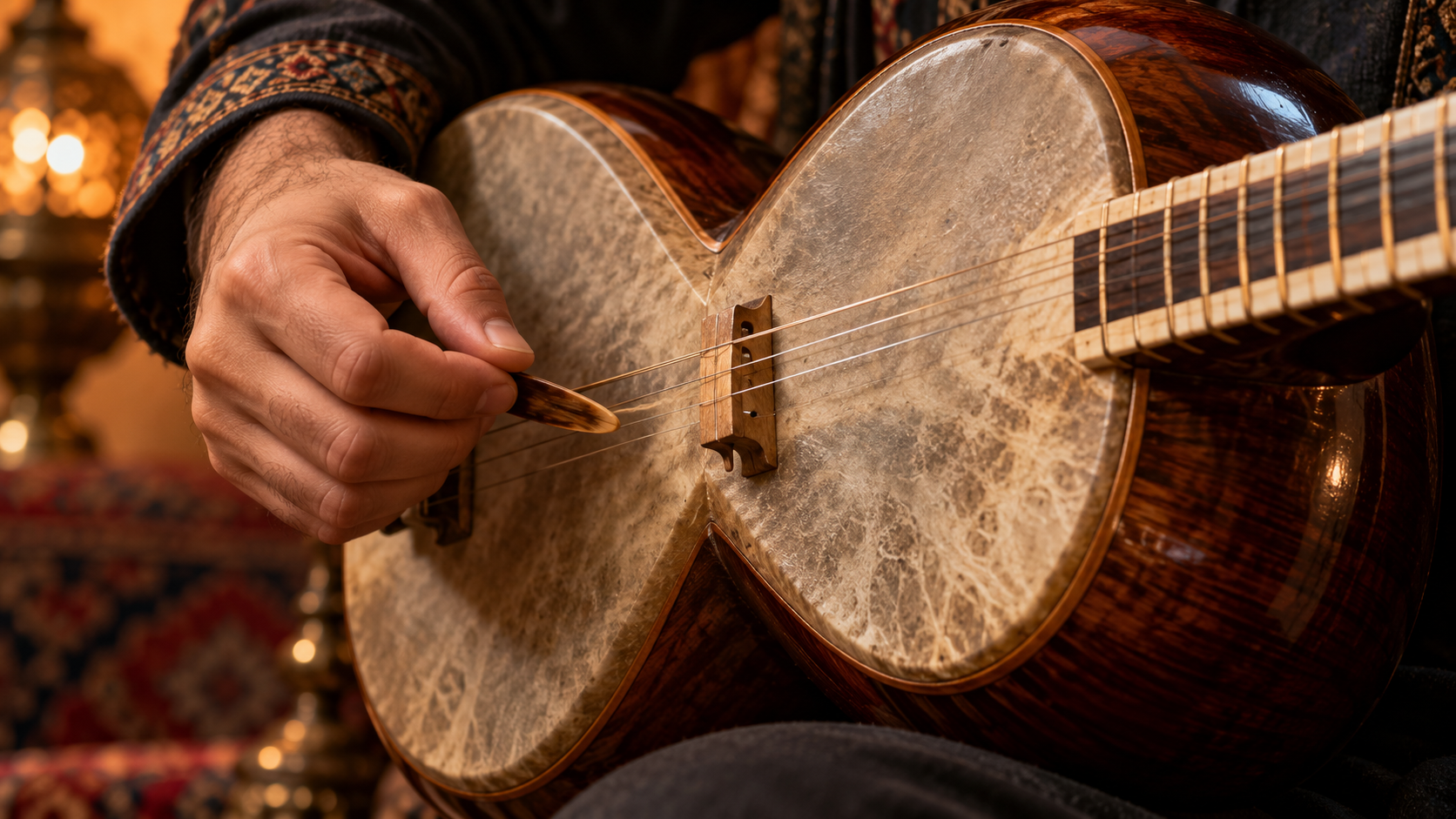
The body of a Persian Tar immediately looks different from that of a guitar. Its double-bowl shape, carved from wood, is distinctive enough, but one of its most interesting construction features becomes apparent when you look at the front of the instrument. Instead of the solid wooden soundboard found on many familiar string instruments, a traditional Tar uses a stretched membrane.
The Persian Tar skin soundboard plays a major role in creating the instrument's recognizable tone. When the strings are struck with the mezrab, their vibration travels through the bridge and into this thin membrane. The membrane responds quickly to the energy of the strings and helps produce the Tar's bright, powerful, and highly responsive voice.
This construction may seem unusual to someone accustomed to guitars, violins, or other wooden-topped instruments, but it is central to the design of the Tar.
A Soundboard Is More Important Than It Looks
Strings by themselves are not very loud.
If a string is stretched tightly between two points and plucked without being attached to a resonant body, it creates only a small amount of audible sound.
An acoustic instrument therefore needs a structure that can receive the vibration of the strings and move a larger amount of air.
On a guitar, much of this work is performed by a thin wooden top.
On a violin, string energy travels through the bridge into the wooden body.
On the Tar, a stretched membrane performs an important part of that job.
The choice of material has a major effect on how quickly and strongly the instrument responds.
How String Vibration Reaches the Tar's Membrane
When a Tar player strikes a string, the vibrating string transfers energy to the bridge.
The bridge rests on the stretched skin covering the front of the bowls.
As the bridge moves, it causes the membrane to vibrate.
Those vibrations interact with the carved wooden body and the air inside the resonating chambers, producing the sound that reaches the listener.
This chain happens extremely quickly.
String, bridge, membrane, body, and air all contribute to the final result.
That is why the membrane should not be viewed as a decorative covering. It is an active acoustic component.
Musicians exploring the Persian Tar are essentially playing a system in which wood, stretched skin, metal strings, and a brass plectrum all contribute to the instrument's personality.
Skin Responds Differently From a Wooden Top
A stretched membrane behaves differently from a carved or braced wooden soundboard.
Because it is thin and held under tension, it can respond rapidly to the attack of the string.
This contributes to the immediacy heard when the Tar is played with a mezrab.
Notes can begin with a strong, clear attack while still carrying the resonance of the instrument's hollow body.
A wooden top has its own complex stiffness, grain structure, thickness, and resonance.
Neither design is inherently better.
They simply create different acoustic behaviour.
The Tar evolved with a membrane because that sound became part of the instrument's musical identity.
Why the Tar Does Not Simply Sound Like a Drum
Seeing stretched skin on a musical instrument may make someone think immediately of a drum.
There is an important difference.
A drum player normally strikes the membrane directly, causing the skin itself to initiate the sound.
On the Tar, the player strikes the strings.
The bridge then transfers string vibration to the membrane.
The membrane is therefore acting as part of a string instrument's resonating system rather than functioning as a percussion surface.
That combination contributes to a tone that can be both percussive in its attack and melodic in its sustain.
The Double-Bowl Body Works With the Membrane
The Tar's body is another major part of the equation.
Traditionally carved from mulberry wood, it has a recognizable double-bowl form.
The larger lower chamber and smaller upper chamber create the visual silhouette that makes the instrument immediately identifiable.
Both sections are covered by the membrane.
The resonating body beneath that skin shapes and reinforces the vibrations coming from the strings.
If the same membrane were stretched over a completely different body shape, the resulting sound would not necessarily resemble a Tar.
The instrument works because its components were developed as a system.
This is one reason the construction of traditional Persian instruments is so fascinating. Features that may initially appear ornamental or historical often have direct acoustic purposes.
Membrane Tension Matters
A membrane cannot perform properly without appropriate tension.
If it is too loose, its response changes.
If conditions alter the membrane's tension, the tone and feel of the instrument can also change.
Experienced players and makers therefore pay attention to the condition of the skin as part of the instrument's overall setup.
This also helps explain why the Tar can feel especially responsive.
The bridge is interacting with a lightweight surface held under tension.
Small changes in how a player strikes the strings can be transmitted effectively through the bridge.
The result is an instrument capable of a surprisingly broad range of articulation.
The Mezrab Completes the Attack
The Tar's sound is not created by its membrane alone.
The traditional plectrum, or mezrab, gives the strings their initial energy.
The player can vary the strength, angle, speed, and rhythmic pattern of each stroke.
That attack then travels through the rest of the instrument.
A strong stroke can produce an assertive sound.
A controlled light stroke can reveal a much more delicate side of the Tar.
Rapid alternating strokes create sustained musical textures even though each individual string naturally loses energy after being plucked.
The responsiveness of the membrane helps preserve the detail of these attacks.
Why Not Replace the Skin With Wood?
In theory, an instrument maker could experiment with creating a Tar-shaped instrument using a wooden top.
But changing the soundboard material would change the acoustic system.
The resulting instrument might still be interesting, but it would not respond in exactly the same way as a traditional Tar.
The skin membrane is part of what musicians expect when they hear the instrument.
Instrument design is often the result of generations of refinement.
Once players develop performance techniques around a certain response, the construction and technique begin influencing each other.
The Tar's mezrab strokes, ornamentation, dynamic control, and tonal expectations developed alongside the physical instrument.
Replacing a fundamental component would therefore affect more than appearance.
The Tar's Sound Fits Persian Classical Music
The Tar occupies an important role in Persian classical music.
Its clear articulation allows complex melodic passages to remain defined, while its resonance gives individual notes weight and character.
The instrument can lead an ensemble, accompany another musician, or perform alone.
Its movable frets also allow it to reproduce the characteristic pitches required by the Persian modal system.
Readers interested in the wider repertoire can explore Radif in Persian music to understand how instruments such as the Tar are used within a larger framework of dastgahs and gushehs.
The Tar's construction is particularly well suited to this repertoire because it combines precision with expressive variation.
Why Different Tars Can Sound Different
Two Tars built to the same general design can still sound noticeably different.
The quality and dimensions of the wooden body matter.
The bridge matters.
The strings matter.
The membrane matters.
The precise workmanship of the maker matters.
Even the setup and condition of the instrument affect how efficiently vibrations move through the system.
Then the musician adds another layer.
Different players attack the strings differently, use different dynamic ranges, and shape phrases according to their own interpretation.
This is why buying a handmade acoustic instrument is not always as simple as selecting a model number.
Whenever possible, hearing and comparing instruments can help a musician understand the differences.
The Skin Is Delicate but Musically Valuable
Using a membrane introduces considerations that a thick solid surface would not have.
The player should treat the Tar carefully and avoid unnecessary physical pressure on the skin.
Storage conditions are also worth considering because traditional acoustic instruments can react to their environment.
This does not mean a Tar is impractical.
It simply means that the same material responsible for an important part of the instrument's sound deserves appropriate care.
Musicians routinely care for bows, reeds, strings, drumheads, wooden soundboards, and other sensitive components.
The Tar membrane belongs in the same category.
A Design Choice You Can Hear
The Persian Tar skin soundboard is one of the clearest examples of how instrument construction shapes musical identity.
The Tar does not use skin because its makers lacked access to wood or because it represents an outdated construction technique.
The membrane provides a distinctive acoustic response that works together with the carved wooden bowls, bridge, metal strings, movable frets, and mezrab.
Remove or fundamentally change one of those components and the character of the instrument changes with it.
For listeners, this construction helps explain why a Tar can sound so immediate and resonant at the same time.
For musicians, it reveals why craftsmanship and setup matter so much when comparing instruments.
Visit Rhythm Music Shop in Markham to explore Persian Tar models and other traditional instruments in person. Whether you are beginning Persian music or upgrading your current instrument, contact Rhythm Music Shop for help comparing instruments, accessories, strings, and learning materials.