
General Articles
Why Is the Setar Played With a Fingernail Instead of a Pick?
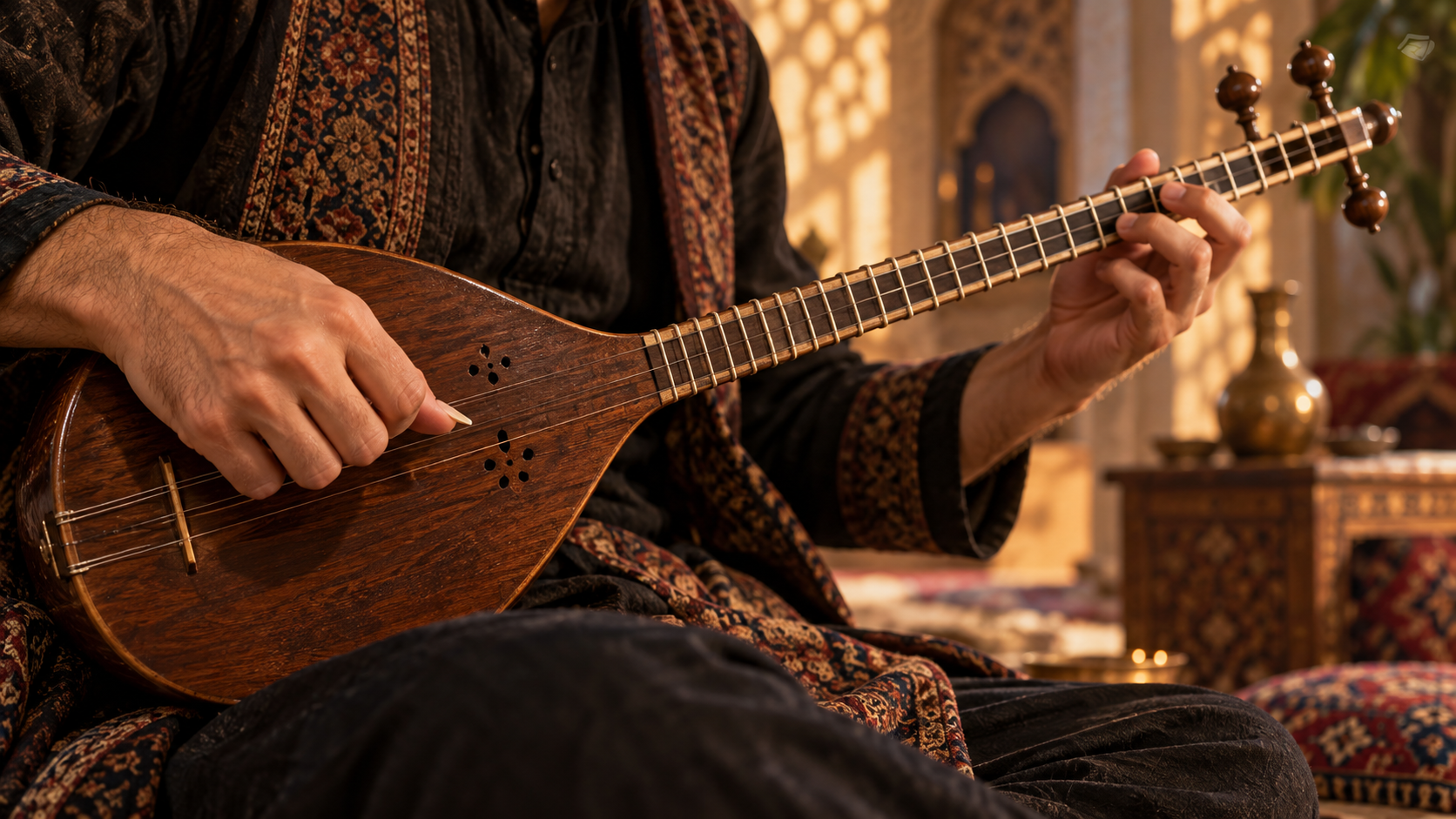
Watch an experienced Setar player closely, and one detail immediately separates the instrument from many other plucked string instruments. There is usually no conventional guitar pick in the player's hand. Instead, the index fingernail of the right hand becomes the plectrum.
The Setar fingernail technique is one of the defining elements of the instrument's sound and playing style. It allows a musician to move quickly between upward and downward strokes, vary the strength of each attack, create flowing tremolo-like textures, and control subtle changes in tone without holding a separate object between the fingers.
This unusual technique is not simply a traditional habit. The fingernail and the Setar developed into a highly compatible musical combination.
The Setar Is Built for a Delicate Form of Plucking
The Setar is a long-necked Persian string instrument known for its light construction and intimate sound.
Modern Setars typically have four strings, despite the instrument's name historically referring to three strings. Its body is comparatively small, and its sound is much quieter and more delicate than the powerful projection of instruments such as the Tar.
Because the instrument responds to small movements, the player's contact with the strings becomes especially important.
Using the fingernail gives the musician direct physical control over every stroke.
There is no separate pick between the player and the string.
That direct contact contributes to the highly responsive character that makes the Setar so expressive.
Why the Index Fingernail Works So Well
A fingernail has several useful qualities as a natural plectrum.
It is firm enough to set a metal string into motion clearly, but it remains physically connected to the finger. The musician can therefore adjust its angle almost instantly.
A slight change in the finger can alter how much nail contacts the string, how sharply it releases, and how strong the note becomes.
With a separate pick, the player also has control, but the mechanics are different. The pick has its own thickness, shape, stiffness, and surface.
With the Setar, the player's fingernail effectively becomes part of the instrument's sound-producing system.
Upward and Downward Motion
One of the most important advantages of the technique is the ability to alternate direction efficiently.
The index finger can strike across the strings in one direction and return in the opposite direction.
This makes rapid patterns possible without gripping a separate plectrum.
The movement can remain small and economical, which is important when performing intricate Persian melodic passages.
Over time, players develop very precise control over how far the finger moves and how deeply the nail engages the strings.
The Fingernail Helps Shape the Setar's Tone
The Setar is famous for a voice that can feel quiet, detailed, and almost conversational.
Part of that character comes from the instrument's construction, but the point of contact at the string also matters.
A hard, thick pick can produce a sharper attack than a carefully controlled fingernail. A very soft contact might reduce clarity.
The fingernail provides a useful balance.
It creates enough definition for ornaments and rapid passages while allowing the player to soften the stroke when a more restrained sound is wanted.
This is particularly important because Persian classical music frequently relies on subtle changes in articulation rather than simply switching between loud and quiet playing.
The Finger Is Responsible for More Than Individual Notes
Beginners may imagine Setar technique as simply plucking one string at a time.
In practice, the right hand develops a much larger vocabulary.
Players can produce single strokes, repeated strokes, rhythmic patterns, accents, flowing passages, and different combinations of attack.
The finger can move across more than one string or concentrate on a specific course.
Because the same finger performs so many functions, the player's control becomes increasingly refined with experience.
This helps explain why the right-hand technique deserves as much attention as learning where notes are located with the left hand.
The Technique Fits Persian Radif Performance
The Setar has an important connection with Persian classical repertoire and improvisation.
Students learning Persian Radif music spend years absorbing melodic phrases, ornaments, modal relationships, and stylistic details.
Many of those details depend heavily on articulation.
Two musicians can play the same sequence of pitches yet produce very different musical results because of how they attack, emphasize, repeat, or connect the notes.
The fingernail gives the Setar player a particularly immediate way to shape these details.
A stronger stroke can bring a note forward. A lighter stroke can allow another phrase to feel restrained. Rapid repeated attacks can increase intensity without requiring the player to change instruments or equipment.
Nail Shape Can Affect Playing
Since the nail is functioning like a plectrum, its condition matters.
A rough edge may catch unexpectedly on a string.
A damaged nail can change the player's attack or make certain movements uncomfortable.
An excessively long nail may also become difficult to control.
For this reason, serious players often pay attention to the shape and smoothness of the playing nail.
There is no single nail shape that every musician must use because hand anatomy and technique vary.
What matters is that the nail provides predictable contact with the string.
It Is Not About Growing an Extremely Long Nail
A common misconception is that Setar players need a dramatically long fingernail.
The goal is not length for its own sake.
The nail simply needs to extend enough to interact with the string effectively according to the player's technique.
Too much length can actually make the nail less stable and more vulnerable to breaking.
Control is more important than appearance.
Why Not Simply Use a Guitar Pick?
A guitar pick can certainly make a string vibrate, so the question is reasonable.
However, substituting a pick changes the mechanics that traditional Setar technique is built around.
The player's grip changes. The angle of contact changes. Alternating strokes are produced through a different hand movement. The tactile relationship between the finger and string is also reduced.
More importantly, traditional Setar repertoire and technique developed around the use of the index fingernail.
Using another tool may still produce musical sounds, but it no longer reproduces the same playing approach.
That is similar to replacing the traditional mezrab of another instrument with a completely different striking tool. The strings still vibrate, but the character of the attack and the player's control may change.
The Left and Right Hands Work Together
The Setar's expressive sound does not come from the fingernail alone.
The left hand presses the strings against movable frets and performs ornaments, slides, vibrato-like movements, and rapid changes in pitch.
The right hand determines how those notes begin and how strongly they speak.
The best performances result from coordination between both hands.
A beautifully ornamented left-hand phrase can lose its character if every right-hand stroke sounds identical.
Likewise, sophisticated right-hand articulation cannot compensate for inaccurate fingering or poorly placed frets.
The two sides of the instrument constantly interact.
Students exploring traditional Persian instruments often discover that this coordination is one of the most rewarding aspects of learning them.
The Fingernail Creates an Unusually Personal Sound
Every musician's hand is slightly different.
Nail thickness, finger angle, hand position, strength, and movement all vary.
As a result, the Setar is capable of reflecting a player's physical technique in a very direct way.
Two musicians using the same instrument can produce noticeably different attacks and tonal qualities.
That individuality suits Persian classical music particularly well because interpretation and improvisation are so important.
A performer is not simply activating predetermined notes. The musician is continually shaping how each phrase breathes and responds.
Beginners Need Time to Develop a Consistent Attack
Producing a sound on a Setar is not particularly mysterious, but producing an even and controlled sound takes practice.
Early students may notice that some strokes sound stronger than others.
The nail may occasionally catch the string. Upward and downward movements may not initially sound equal.
These inconsistencies are normal parts of developing the technique.
Slow practice allows the hand to learn the correct distance from the strings and the smallest movement required for a clear attack.
Eventually, what initially feels like a very deliberate movement can become almost automatic.
That frees the musician to focus on melody, rhythm, ornamentation, and interpretation.
The Strings Also Influence the Response
The relationship between nail and string depends on the condition and type of strings installed on the instrument.
Old, damaged, or unsuitable strings may respond differently from fresh strings.
Players who maintain their instruments should therefore pay attention not only to tuning but also to wear and general string condition.
Rhythm Music Shop carries strings and instrument accessories for musicians maintaining traditional Persian instruments as well as other string instruments.
A properly set-up Setar with suitable strings provides a much better environment for developing right-hand control.
One Finger Becomes Part of the Instrument
The most interesting part of the Setar fingernail technique is how little equipment is involved.
The player does not need a complicated mechanical device to create a wide range of attacks.
The fingernail itself becomes the plectrum, and tiny variations in movement produce noticeable musical changes.
That directness suits the Setar's intimate personality.
Its quiet voice encourages careful listening, and its right-hand technique gives the musician detailed control over how every phrase begins.
The result is an instrument in which the player's own hand becomes unusually closely connected to tone production.
If you are interested in learning Setar or comparing handmade Persian instruments, visit Rhythm Music Shop in Markham. We carry Setars, traditional instruments, strings, accessories, and Persian music books for different experience levels. Contact Rhythm Music Shop, and our team can help you find the right instrument and accessories for your musical needs.