
General Articles
Why Do Persian Instruments Use Movable Frets Instead of Fixed Frets?
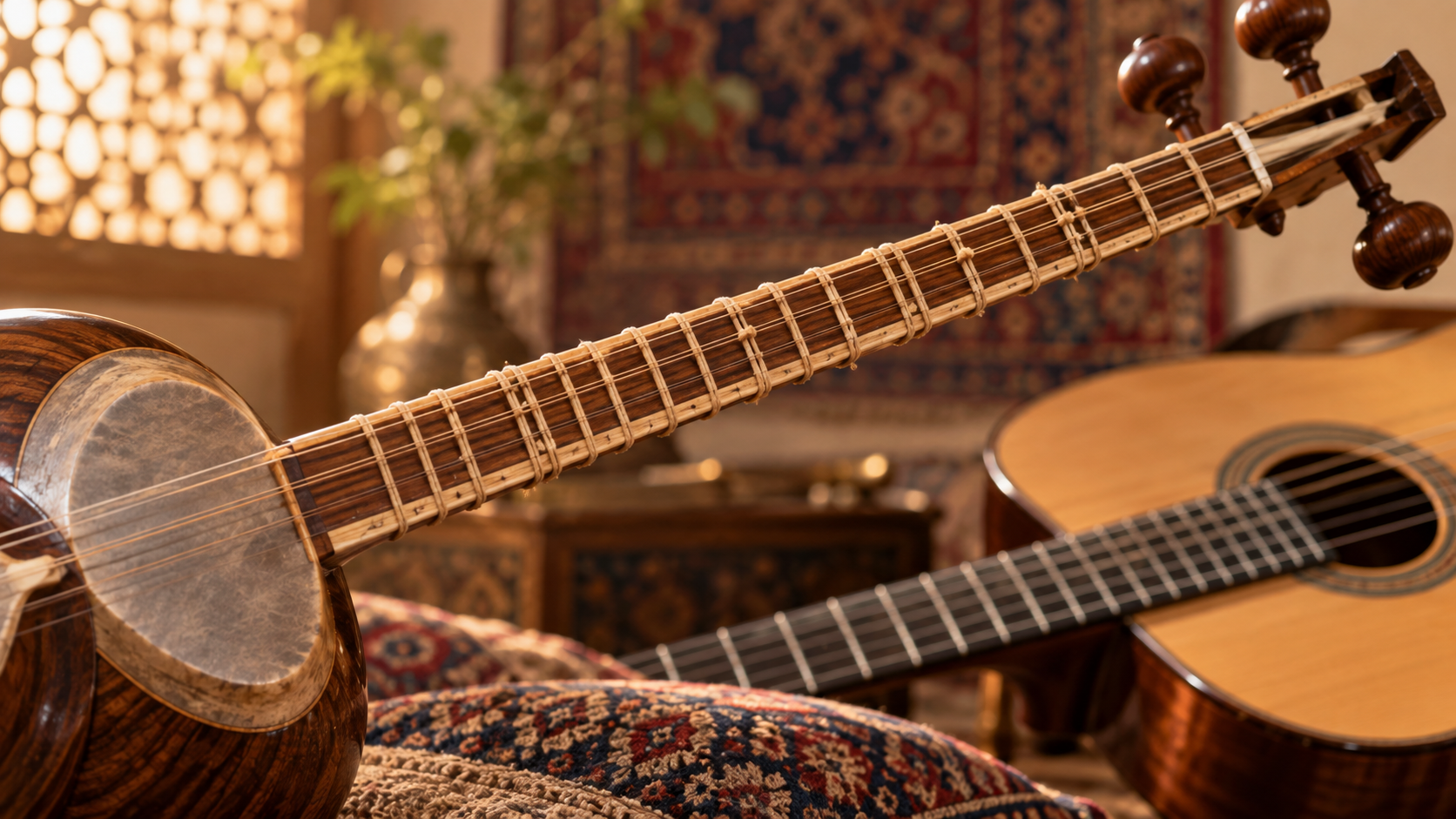
At first glance, the neck of a Tar or Setar may look similar to that of many other string instruments. There are strings running over a long neck, with a series of frets showing the musician where notes can be played. Look more closely, however, and an important difference becomes obvious. Instead of permanent metal frets embedded into the fingerboard, these instruments traditionally use tied frets that can be moved.
The movable frets on Persian instruments are not simply an old-fashioned construction method that survived into modern times. They are directly connected to the way Persian classical music organizes pitch, melody, and musical modes. Their adjustability gives musicians control over intervals that would be difficult to reproduce accurately with the evenly spaced fixed frets found on a standard Western guitar.
Understanding why these frets move reveals a great deal about the relationship between Persian instruments and the musical system they were designed to perform.
Fixed Frets Work Well for a Fixed Tuning System
Most modern guitar players are familiar with fixed metal frets. Once a guitar has been manufactured, each fret remains in a predetermined position. The spacing becomes progressively smaller as the frets approach the body because each fret shortens the vibrating length of the string by a calculated amount.
On a modern Western guitar, the fret positions normally follow twelve-tone equal temperament. An octave is divided into twelve equally spaced semitones.
That arrangement is extremely practical. A guitarist can change keys, play chords, and move patterns around the neck without physically changing the instrument.
Persian classical music, however, developed around a different musical language.
Certain pitches and intervals used in Persian melodies do not always correspond exactly with the notes available on a standard equal-tempered guitar. A permanently fixed fret system could therefore restrict the player's ability to reproduce the intonation associated with different Persian modes.
This is where movable frets become particularly useful.
What Are Movable Frets?
On instruments such as the Persian Tar and Setar, traditional frets are created by tying material around the neck rather than inserting metal bars into the fingerboard.
Historically, gut has commonly been used, although modern instruments may also use synthetic materials.
Several strands are wrapped around the neck and tied firmly enough to remain stable while the instrument is being played. At the same time, the fret can be repositioned when necessary.
This gives the musician or instrument maker the ability to make extremely small adjustments to where a note sounds.
The system is simple from a mechanical perspective, but musically it provides enormous flexibility.
Players exploring traditional Persian instruments quickly notice that the fret layout does not look identical to a Western guitar. Some frets appear unusually close together because they represent pitches used within the Persian modal system.
Persian Music Uses More Than Western Semitones
One reason movable frets are so important is that Persian classical music includes intervals that fall between familiar Western equal-tempered notes.
These pitches are sometimes described casually as quarter tones, but that description can be misleading if it suggests that every interval simply divides a Western semitone exactly in half.
Persian intonation is more flexible and is strongly influenced by musical context, tradition, the specific dastgah being performed, and the interpretation of the musician.
Two particularly recognizable symbols in Persian notation are koron and sori. Koron generally indicates that a pitch should be lowered relative to its natural form, while sori indicates a raised pitch.
The exact musical character of these notes cannot always be captured by imagining a piano keyboard with extra keys placed exactly halfway between the existing ones.
Persian musicians learn the intervals through listening, repetition, repertoire, and close attention to the phrasing of experienced performers.
Movable frets allow a fretted instrument to participate in that musical language.
How Movable Frets Support the Dastgah System
To understand the purpose of the frets, it helps to understand the basic concept of dastgah.
A dastgah is a modal framework used in Persian classical music. Within each dastgah are numerous melodic pieces and patterns known as gushehs. These melodies form part of the larger repertoire known as the Radif in Persian music.
The important point is that Persian classical music is not based solely on moving through one universal collection of equally spaced notes.
Different modes emphasize different pitches, relationships, melodic tendencies, and characteristic intervals.
For a Tar or Setar player, having adjustable frets means the neck can be configured so those important pitches fall where they should for the repertoire being performed.
A Few Millimetres Can Matter
The difference between an appropriate pitch and an uncomfortable one may require only a small change in fret position.
Moving a fret slightly toward the bridge raises the resulting pitch because the vibrating portion of the string becomes shorter.
Moving it toward the nut lowers the pitch because the vibrating length becomes longer.
Experienced musicians develop an ear for these relationships rather than relying entirely on visual measurements.
This is one reason learning traditional Persian music involves much more than memorizing finger positions.
The Tar Shows the System Clearly
The Persian Tar provides one of the clearest examples of movable frets in action.
Its long neck contains numerous tied frets that make it possible to perform the subtle intervals required throughout Persian classical repertoire.
The player's left hand presses the string against those frets while the right hand uses a mezrab to strike the strings.
Because the instrument can produce powerful, clearly articulated notes, intonation becomes especially noticeable. Even a small difference in fret placement can change the character of a melodic phrase.
This means the fret arrangement is part of the instrument's musical setup, just as tuning the strings is.
A Tar can have perfectly tuned open strings while certain stopped notes still sound inappropriate if its frets are positioned incorrectly.
The Setar Uses the Same Principle Differently
The Setar also uses tied movable frets, but its lighter construction and softer voice create a different playing experience.
The instrument is normally plucked with the fingernail and responds to extremely small variations in touch.
Its subtle sound makes the relationship between pitch, ornamentation, vibrato, and melodic expression particularly important.
Because the Setar is frequently used for intimate solo performance and Radif study, careful fret placement helps the player reproduce the tonal character of each mode.
For students, this can initially seem unusual.
A guitar student usually assumes that every fret is permanently correct because the manufacturer installed it in a fixed position. A Setar student gradually learns that tuning involves more than adjusting the strings.
The neck itself is part of the tuning system.
Why Not Replace Them With Permanent Metal Frets?
From a manufacturing perspective, fixed metal frets might seem easier.
They are durable, familiar to many musicians, and do not require periodic repositioning.
The problem is that permanent frets would remove one of the instrument's most useful forms of flexibility.
A modern maker could certainly build a Tar or Setar with metal frets arranged for one particular tuning system, but that would force the instrument into a predetermined set of pitches.
Traditional movable frets preserve the ability to modify those relationships.
They are also replaceable when worn.
Instead of removing a metal fret from a fingerboard and installing a new one, the tied material can simply be replaced and positioned again.
Movable Does Not Mean the Frets Constantly Slide Around
The term "movable fret" can create another misconception.
The frets are not supposed to slide every time a musician presses a string.
Once positioned correctly and tied with suitable tension, they should remain stable during normal playing.
"Movable" means they can intentionally be repositioned during setup or when musical requirements change.
A properly prepared instrument should feel secure beneath the fingers.
If a fret is constantly moving while the musician plays, it is usually a setup problem rather than a normal feature of the instrument.
The Musician's Ear Remains Essential
Electronic tuners are extremely useful for tuning open strings, but Persian classical music cannot be reduced entirely to numbers displayed on a screen.
A tuner may tell you that an open string is accurately tuned to a specific frequency. It cannot automatically determine the expressive intonation required in every gusheh or musical context.
Traditional training therefore places tremendous importance on listening.
Students hear phrases performed by their teachers, reproduce them, compare their intonation, and gradually learn where each note should sit.
The movable fret system supports this ear-based tradition.
Instead of forcing every musician into one permanent mathematical grid, the instrument provides room for adjustment.
Why This Old Design Still Makes Sense Today
Many traditional design features disappear when modern manufacturing introduces easier alternatives.
Movable frets have remained relevant because they still solve a real musical problem.
They allow a fretted instrument to preserve the pitch flexibility required by Persian music while still giving the player the tactile reference of a fret.
A completely fretless instrument offers even greater pitch freedom, but it requires the player to locate every note without physical divisions.
The Tar and Setar provide an interesting middle ground.
The musician receives the precision and physical feedback of frets while retaining the ability to modify their placement.
That balance is one of the reasons these instruments remain so well suited to Persian classical repertoire.
A Small Detail That Reveals an Entire Musical System
Those pieces of material wrapped around a Tar or Setar neck may look like a minor construction detail, but they reveal how closely an instrument can be shaped by the music it serves.
The movable frets on Persian instruments allow musicians to reach pitches that do not fit neatly into the fixed fret arrangement familiar to Western guitar players. They support the modal structure of Persian music, make subtle adjustments possible, and preserve a tradition in which listening remains central to accurate intonation.
For anyone examining a Tar or Setar for the first time, the movable frets are therefore worth noticing. They are not an imperfect version of modern metal frets. They are a deliberate solution created for a different musical language.
If you would like to explore Persian Tar, Setar, or other traditional instruments in person, visit Rhythm Music Shop in Markham. Our team can help you compare instruments, accessories, strings, and learning materials. Contact Rhythm Music Shop if you have questions or need help choosing an instrument that suits your experience and musical goals.
Internal Links to Add
traditional Persian instruments
https://rhythmmusicshop.com/collections/persian-instruments
Radif in Persian music
https://rhythmmusicshop.com/blogs/general-articles/what-is-radif-in-persian-music-a-deep-dive-into-a-classical-tradition
Persian Tar
https://rhythmmusicshop.com/pages/tar-persian-string-instrument
Setar
https://rhythmmusicshop.com/pages/setar-persian-string-instrument-3