
General Articles
Why Do Instruments Made From the Same Wood Sound Different?
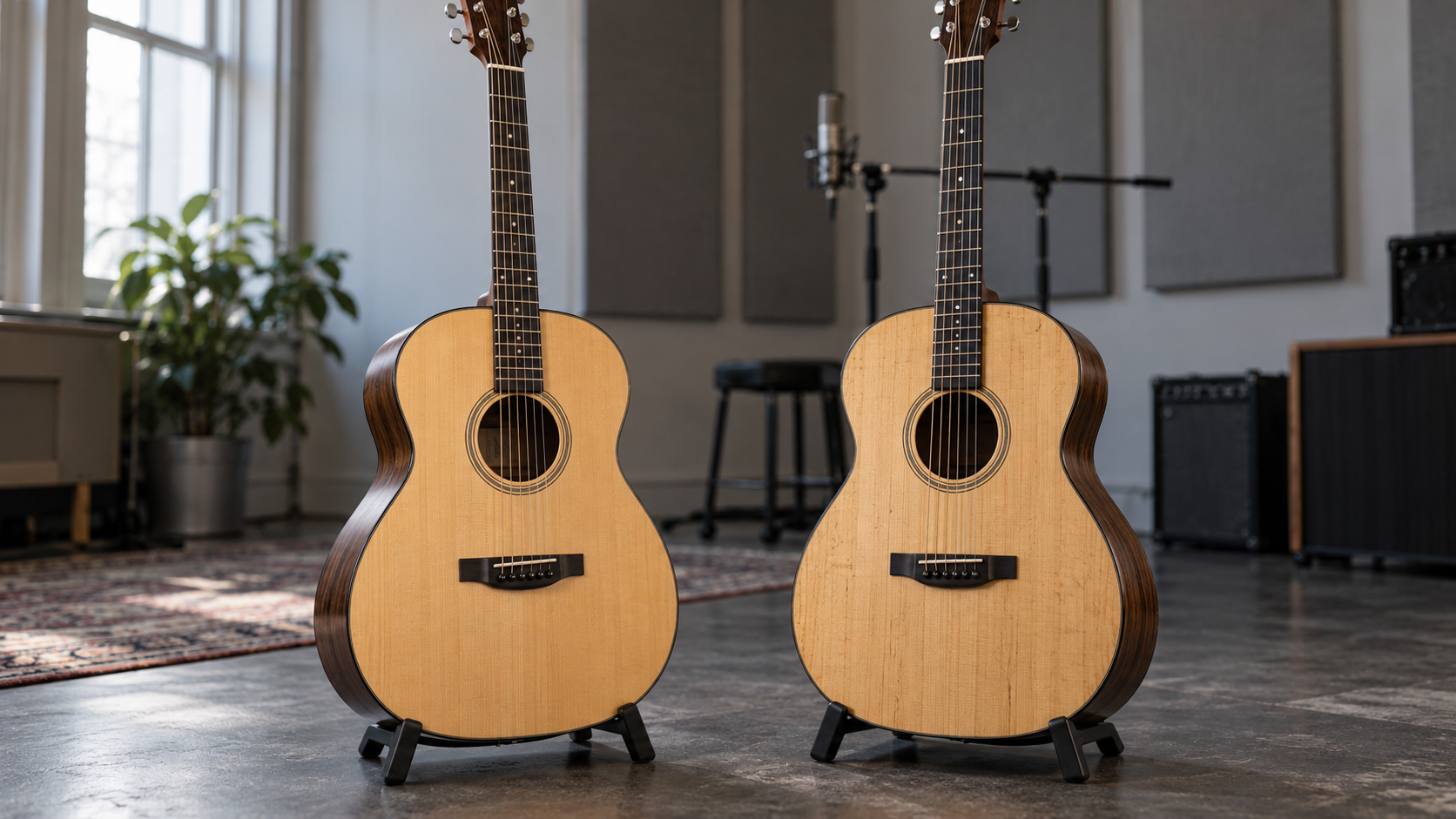
Imagine visiting a music shop and testing two handcrafted Setars. Both have mulberry wood bowls, walnut necks, and similar strings. Their dimensions appear nearly identical, and both were built using traditional methods.
Yet when you play them, one produces a clear, focused tone while the other sounds softer, with a different balance of resonance and sustain.
Why do instruments sound different when they are made from the same wood?
The explanation involves much more than the species of timber used during construction.
Every piece of wood has individual physical characteristics, and small differences in shaping, assembly, and setup affect how an instrument vibrates. Even instruments produced by the same craftsman can respond differently.
Understanding these variations helps musicians evaluate instruments more confidently and appreciate why craftsmanship matters as much as material selection.
The Same Species of Wood Does Not Mean Identical Material
Wood is a natural material with considerable internal variation.
Two pieces of mulberry, walnut, maple, or spruce can have different mechanical properties, even when they come from the same tree.
These differences influence how the material bends, vibrates, and absorbs energy.
Wood Density
Density describes the amount of mass contained within a given volume of material.
Wood density varies according to several factors, including growing conditions, the location of the wood within the tree, and its anatomical structure.
Density matters because it affects how a component responds to vibration.
However, density alone does not determine whether an instrument will produce a bright or warm sound.
A dense piece of wood may behave differently depending on its stiffness, dimensions, and placement within the instrument.
The finished structure is more important than any single material characteristic.
Stiffness and Flexibility
Stiffness describes how strongly a material resists deformation when force is applied.
An instrument component must often be stiff enough to maintain its shape while remaining capable of vibrating.
For example, an acoustic guitar soundboard needs to respond to energy transferred from the strings.
If its structure is too rigid in certain areas, its vibrational response may differ from a more flexible design.
However, excessive flexibility can introduce structural problems or unwanted resonances.
Instrument makers therefore work with the relationship between stiffness, mass, and geometry.
This interaction helps explain how instrument craftsmanship affects sound quality and why wood selection is only the beginning of the construction process.
How Wood Grain Influences Sound
Wood grain is often associated with an instrument's appearance.
Musicians may admire straight grain, distinctive patterns, or unusual figuring.
However, grain also reflects the internal arrangement of the wood's structure.
Grain Direction
Wood behaves differently along and across its grain.
Its stiffness, strength, and dimensional movement are generally not identical in every direction.
This property is known as anisotropy.
When instrument makers shape components, they must consider how the grain is oriented.
A piece of wood cut in one direction may respond differently from another piece of the same species.
This becomes particularly important in thin vibrating components.
Grain Spacing
Some pieces of wood display closely spaced growth rings, while others have wider spacing.
These differences can reflect growing conditions and internal material structure.
However, narrow grain spacing does not automatically indicate better acoustic quality.
Two pieces with similar visible grain can still possess different densities and stiffness values.
Likewise, unusual grain patterns do not necessarily make wood unsuitable.
The relevant question is whether the material's actual properties meet the requirements of the instrument.
Why Appearance Can Be Misleading
A beautifully figured piece of wood may be visually impressive without offering a particular acoustic advantage.
Conversely, a relatively plain piece may perform exceptionally well when shaped and assembled correctly.
This is one reason musicians should avoid judging an instrument solely by its finish or wood grain.
Why Soundboard Thickness Makes Such a Difference
One of the most significant differences between otherwise similar instruments can be the thickness of their vibrating components.
Consider two acoustic guitars made with the same wood species.
If their soundboards differ slightly in thickness, they may respond differently to string vibration.
Thickness Changes Both Mass and Stiffness
Reducing the thickness of a wooden plate decreases its mass.
It also changes its resistance to bending.
Importantly, bending stiffness can change much more rapidly than thickness itself.
This means relatively small differences in a soundboard's dimensions may produce noticeable changes in its mechanical behaviour.
A maker cannot simply reduce thickness indefinitely to improve resonance.
An excessively thin soundboard may become structurally unstable or respond poorly.
Likewise, making it thicker does not necessarily improve strength without affecting acoustic performance.
The challenge is finding a suitable relationship between durability and responsiveness.
Why Precision Matters
Experienced instrument makers may adjust thickness in particular areas to influence the finished instrument's behaviour.
Even when two instruments follow the same general design, differences in these adjustments can influence their sound.
This is particularly relevant when comparing handcrafted acoustic instruments, where individual shaping and construction decisions can vary from one instrument to another.
Instrument Shape Influences Resonance
Wood is only one component of an acoustic instrument.
The dimensions and shape of the resonating body also affect how sound develops.
An acoustic guitar, Persian Tar, and Setar may all use wooden components, but their construction methods are very different.
Body Size and Internal Volume
The internal air volume of a hollow instrument influences its acoustic behaviour.
A larger cavity does not automatically create a better or deeper tone, but its dimensions affect the frequencies at which the air and surrounding structure resonate.
The shape of the body, sound openings, and vibrating surfaces also matter.
Two instruments with similar external dimensions may have different internal shapes.
These variations can affect frequency response and tonal balance.
Structural Components
Internal supports, braces, joints, and other structural features influence how vibrations move through an instrument.
Their dimensions and positioning can affect stiffness and energy transfer.
Small changes in construction may therefore influence sound even when the visible materials appear identical.
These relationships are explained further in the science behind instrument resonance.
Why Two Persian Setars Can Sound Different
The Persian Setar provides an interesting example because its delicate sound makes subtle differences in response noticeable.
Traditional Setars commonly use wooden bowls, thin soundboards, long necks, and tied frets.
Although their general design is recognizable, different makers may use distinct body shapes, construction methods, and dimensional preferences.
The Setar Bowl
A Setar's resonating body may be carved from a single piece of wood or constructed from separate wooden ribs.
Each approach involves different manufacturing processes.
The resulting instrument's response depends on its dimensions, material properties, wall thickness, and assembly.
Even two bowls made from mulberry wood can have different vibrational behaviour.
Soundboard Construction
The Setar's soundboard is responsible for converting string vibrations into a more audible acoustic response.
Its thickness, stiffness, attachment, and relationship with the bridge influence tonal characteristics.
Small differences in these properties can affect how the instrument responds to delicate plucking.
Neck and Fret Setup
The Setar's neck contributes to playing comfort and the relationship between the strings and frets.
An instrument with inaccurate fret positioning or unsuitable string height may produce buzzing or inconsistent intonation.
These problems can influence the listener's impression of sound quality.
However, they are not necessarily caused by the wood itself.
Musicians comparing instruments can examine examples such as the Setar Delava, which combines a mulberry wood bowl with a walnut neck and other traditional components.
Comparing instruments built from similar materials can reveal the importance of the complete design.
Why Two Persian Tars Can Have Different Tonal Characteristics
The Persian Tar presents a different acoustic structure.
Its distinctive double-bowl wooden body is covered by a stretched membrane.
The strings transfer energy through a bridge positioned on that membrane.
As a result, the final sound depends on the interaction between several different materials.
The Wooden Body
The Tar's carved body influences the instrument's structure and acoustic behaviour.
Differences in internal dimensions, wall thickness, and wood characteristics may affect how it responds.
Even when two bodies are made from mulberry wood, they may not behave identically.
The Membrane
The skin membrane adds another important variable.
Its thickness, tension, condition, and preparation influence how it responds to vibration.
Two Tars with very similar wooden bodies may therefore produce noticeably different sounds because their membranes are not identical.
The construction principles behind why the Persian Tar uses a skin soundboard demonstrate how multiple materials work together to create the instrument's characteristic voice.
Bridge and String Interaction
The bridge transfers energy from the strings to the membrane.
Its dimensions, placement, and contact with the membrane influence that transfer.
Likewise, string specifications affect the energy delivered during playing.
A difference attributed to wood may actually be caused by the bridge, membrane, or strings.
This illustrates why acoustic comparisons must account for the entire instrument.
Does the Age of Wood Change Its Sound?
Instrument makers frequently discuss the importance of properly dried or seasoned wood.
This has a practical basis.
Wood changes moisture content in response to environmental conditions.
If it is assembled before reaching a suitable moisture condition, it may undergo dimensional changes that affect joints, alignment, or structural stability.
Proper Drying Versus Simply Waiting
Drying wood appropriately is important for reliable construction.
However, keeping timber in storage for an arbitrary number of years does not guarantee better tonal performance.
The condition of the material, its moisture content, and how it is processed matter more than age alone.
Do Instruments Improve With Age?
Some musicians believe that wooden instruments become more resonant after years of playing.
Changes in instruments can occur over time, but establishing exactly why an individual instrument's sound changes is difficult.
Several variables may be involved:
-
Changes in environmental conditions.
-
String replacement.
-
Setup adjustments.
-
Mechanical wear.
-
Repairs.
-
Changes in the musician's technique and listening preferences.
It is therefore important to avoid assuming that every wooden instrument automatically improves as it gets older.
A well-maintained older instrument may perform exceptionally well, but its quality should still be evaluated directly.
How Humidity Changes Wooden Instruments
Wood absorbs and releases moisture as the surrounding humidity changes.
This process can affect its dimensions and mechanical behaviour.
For musicians in Canada, seasonal humidity variation can be particularly important.
Indoor heating during winter often lowers relative humidity, while summer conditions may be substantially more humid.
What Happens During Dry Conditions?
When wood loses moisture, it can shrink.
Depending on the instrument's construction and the severity of the conditions, this may contribute to:
-
Changes in neck alignment.
-
Cracks in wooden components.
-
Changes in string height.
-
Loosened joints.
-
Differences in tonal response.
What Happens During Humid Conditions?
When wood absorbs moisture, it can expand.
Excessive humidity may affect dimensional stability and instrument setup.
The result depends on the species of wood, finish, construction, and environmental exposure.
Musicians should follow appropriate storage practices and avoid sudden environmental changes.
The advice in maintaining wooden instruments in different climates can help protect instruments throughout the year.
Why Instrument Setup Can Be More Important Than Wood Species
It is tempting to attribute every tonal difference to the wood.
However, setup can have a significant effect on how an instrument performs.
Two identical guitars fitted with different strings or adjusted to different string heights may not sound or feel the same.
The same principle applies to traditional Persian instruments.
String Height
String height influences playing comfort and the likelihood of unwanted buzzing.
If strings are too low, they may contact frets or other components during vibration.
If they are excessively high, playing may require unnecessary force.
Bridge Position
The bridge is a critical part of the energy-transfer system.
Its position and contact with the vibrating surface can influence intonation and acoustic response.
String Selection
Different strings may change the instrument's response.
Material, gauge, tension, and condition all matter.
These variables should be considered before concluding that one instrument has better wood than another.
For a closer look at these adjustments, how instrument setup affects sound quality explains their influence on tone and playability.
Can Two Instruments Made by the Same Craftsman Sound Different?
Yes.
A skilled instrument maker can produce instruments with consistent workmanship while still encountering natural material variation.
Even when using similar plans and construction methods, individual pieces of wood differ.
Small changes in shaping and assembly can also influence the finished result.
This does not mean the maker lacks precision.
It reflects the complexity of acoustic instrument construction.
Handmade Instruments Are Not Exact Copies
Traditional handmade instruments often involve individual adjustments.
A craftsman may refine one component differently to accommodate the characteristics of the material being used.
The process can produce subtle differences in response between instruments.
The individuality of handcrafted instruments and why they matter is part of their appeal to many musicians.
However, individuality should not be confused with automatic superiority.
Both handmade and factory-produced instruments can be evaluated according to acoustic response, construction quality, and reliability.
How to Compare Instruments Fairly
When comparing two instruments made from the same wood, it helps to control as many variables as possible.
Otherwise, differences unrelated to wood may influence the result.
Use Similar Strings
Strings should be comparable in material, gauge, condition, and tuning.
Comparing an instrument with new strings against one with heavily worn strings may produce misleading results.
Maintain Similar Playing Conditions
Whenever possible, have the same musician perform the same passages on both instruments.
The playing technique should remain reasonably consistent.
Listen at Similar Distances
The distance and position of the listener can influence perceived tone.
Comparisons are more useful when both instruments are heard from similar positions.
Check the Setup
Before comparing sound quality, confirm that the instruments are properly adjusted.
Unwanted buzzing or poor intonation can interfere with evaluation.
Compare Several Musical Characteristics
Listen for:
-
Clarity across the playing range.
-
Balance between low and high notes.
-
Responsiveness to gentle playing.
-
Sustain and note decay.
-
Dynamic control.
-
Consistency between individual notes.
The goal is not necessarily to identify one universally superior instrument.
Instead, it is to recognize meaningful differences and determine which instrument suits the musician's preferences.
Does the Room Change What You Hear?
An instrument's sound is influenced not only by how it vibrates but also by the environment in which it is played.
Sound reflects from walls, ceilings, floors, and other surfaces.
A small room with hard surfaces may emphasize reflections differently from a larger room containing carpets and upholstered furniture.
Consequently, the same instrument can appear to have a different tonal balance in different spaces.
Why This Matters When Testing Instruments
An instrument tested in a quiet music shop may sound different when played at home.
Likewise, recordings made using different microphones or microphone positions can produce noticeably different results.
Understanding why your instrument sounds different in every environment helps musicians avoid drawing conclusions from comparisons made under inconsistent conditions.
Choosing an Instrument for Its Sound, Not Just Its Materials
Wood selection is important, but it should never be treated as the sole measure of an instrument's quality.
Two instruments built from the same species of wood can differ because their materials possess different physical properties, their components were shaped differently, or their setups are not identical.
Instrument design, strings, bridges, membranes, and environmental conditions all influence the finished sound.
For musicians, this means that a product description cannot replace listening and playing.
A Setar made from mulberry and walnut may be an excellent choice, but those materials alone do not reveal how comfortable or responsive it will be.
The same applies to Persian Tars, acoustic guitars, violins, and other wooden instruments.
Visit Rhythm Music Shop in Markham to explore traditional Persian and Western musical instruments, compare their construction and sound, and find an instrument that feels right for your playing style.