
General Articles
Essential Accessories Every Musician Needs
Musical instruments receive most of the attention when someone begins learning or upgrading their equipment, but the surrounding accessories often have just as much influence on the overall experience. A quality instrument can still become difficult to use if it is poorly stored, rarely cleaned, improperly tuned, or paired with unreliable equipment.
The right accessories help musicians practise more efficiently, protect their instruments from damage, improve comfort, and prepare for lessons or performances. Some items are useful for nearly every musician, while others depend on the instrument being played.
A guitarist may need picks, strings, straps, and cables. A violinist may rely on rosin, a shoulder rest, and a suitable bow. A pianist may need a bench, sustain pedal, and music stand. Traditional instrument players may require specific picks, mallets, cases, or maintenance products.
Understanding which essential accessories provide real value can help musicians avoid unnecessary purchases while making sure they have the tools needed for regular practice and performance.
A Reliable Instrument Tuner
Proper tuning is one of the most important parts of playing music. An instrument that is out of tune can make practice confusing and affect ear development.
A reliable tuner helps musicians check pitch quickly and accurately.
Clip-On Tuners
Clip-on tuners attach to the headstock or another vibrating part of the instrument. They detect vibration rather than relying only on sound.
This makes them useful in noisy rooms, group rehearsals, and performance settings.
They are commonly used with:
- Acoustic guitars
- Electric guitars
- Ukuleles
- Violins
- Setars
- Tars
- Other string instruments
Clip-on tuners are small, portable, and easy to store inside an instrument case.
Pedal Tuners
Pedal tuners are designed primarily for electric guitars and basses. They connect to the signal chain and allow the musician to tune silently.
They are especially useful for live performances because they can mute the signal while tuning.
Tuning Apps
Phone apps are convenient for casual practice, but they may struggle in noisy environments. They also require the musician to keep a phone nearby, which can become distracting.
A dedicated tuner is usually more reliable for lessons, rehearsals, and performances.
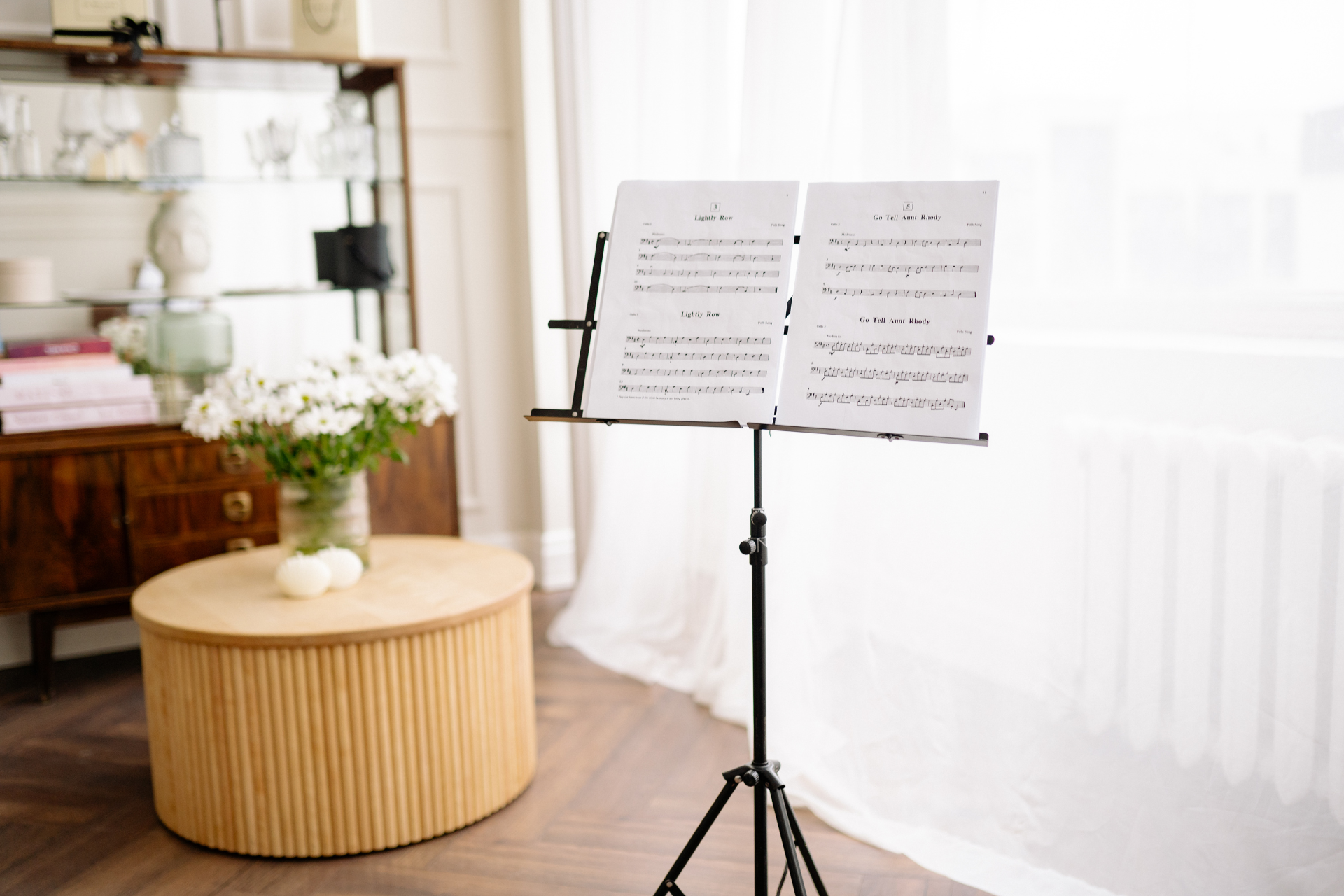
A Sturdy Music Stand
A music stand helps musicians maintain better posture and keep sheet music at a comfortable viewing height.
Without a stand, players may place books on a table, bed, chair, or floor. This can lead to poor posture, neck strain, and interrupted practice.
Folding Music Stands
Folding stands are lightweight and portable. They are suitable for lessons, rehearsals, and musicians with limited storage space.
They can be folded and placed inside a bag or closet.
Solid-Desk Music Stands
Solid stands provide stronger support for heavy books, tablets, and multiple pages of music.
They are useful for home practice and teaching studios.
What to Look For
A good stand should offer:
- Adjustable height
- Stable legs
- A secure music tray
- Easy page placement
- Enough strength for music books
- Simple folding or storage
The stand should remain steady when pages are turned or when the musician adjusts the music.
A Protective Instrument Case
A case is one of the most important essential accessories because it protects the instrument during storage and transportation.
Even musicians who rarely travel should keep their instruments protected from dust, moisture, sunlight, temperature changes, pets, and accidental impact.
Soft Cases
Soft cases are lightweight and easy to carry. They often include shoulder straps and storage pockets.
They work well for local lessons, short trips, and instruments that are not especially fragile.
However, they offer limited protection against heavy impact.
Hard Cases
Hard cases provide stronger protection for delicate or valuable instruments.
They are often preferred for:
- Violins
- Cellos
- Setars
- Tars
- Santurs
- Professional guitars
- Frequently transported instruments
A hard case should fit the instrument properly. Too much empty space can allow the instrument to move, while a case that is too tight may place pressure on delicate parts.
Case Storage Compartments
Useful compartments can hold:
- Rosin
- Picks
- Strings
- Cleaning cloths
- Tuners
- Cables
- Sheet music
- Small tools
Keeping accessories inside the case makes it easier to prepare for lessons and performances.
Cleaning and Maintenance Supplies
Regular cleaning helps instruments last longer and perform more consistently.
Sweat, skin oils, dust, rosin, and moisture can build up over time. This can damage strings, finishes, hardware, keys, and moving parts.
Cleaning Cloths
A soft microfibre cloth is useful for wiping an instrument after each practice session.
Different cloths may be used for:
- Strings
- Instrument bodies
- Fingerboards
- Metal hardware
- Mouthpieces
- Keys
A cloth used for strings or rosin residue should not always be used on polished surfaces.
Instrument-Specific Cleaners
Not every household cleaner is safe for musical instruments. Products containing harsh chemicals may damage finishes, wood, plastic, metal, or glue.
Use cleaners designed for the specific instrument.
Cleaning Rods and Swabs
Wind instruments require cleaning rods, swabs, or pull-through cloths to remove moisture from the inside.
Moisture left inside can cause odours, corrosion, pad damage, and material deterioration.
String Care
String cleaners can help remove dirt and oils, although wiping strings after each session is often the simplest form of maintenance.
Clean strings feel smoother and maintain tone longer.
Replacement Strings
Stringed instruments should always have a spare set available.
Strings can break unexpectedly during practice, lessons, rehearsals, or performances. Waiting until a string breaks before buying replacements can interrupt progress.
Choosing the Correct Strings
Replacement strings should match the instrument and player’s needs.
Consider:
- Instrument type
- String gauge
- Material
- Tension
- Scale length
- Playing style
- Preferred tone
Classical, acoustic, and electric guitars use different strings. Violins, cellos, setars, tars, and santurs also require instrument-specific sets.
Installing the wrong strings can affect playability and may damage the instrument.
Replace Full Sets When Needed
Replacing only one broken string may be acceptable in an emergency, but a full set often provides more balanced tone and tension.
Old strings can sound dull compared with a new replacement.
Picks, Plectrums, and Playing Tools
Small playing tools can have a noticeable effect on tone, control, and comfort.
Guitar Picks
Guitar picks are available in different:
- Thicknesses
- Shapes
- Materials
- Textures
- Sizes
Thin picks are flexible and often work well for light strumming. Medium picks provide more control for general playing. Heavy picks are commonly chosen for lead guitar, precise picking, and stronger articulation.
Players should try several options rather than assuming one pick suits every style.
Traditional Instrument Picks
Traditional string instruments may require specialized picks.
Setar and tar players use techniques and tools suited to the design of the instrument. Santur players use mezrabs, which influence articulation, speed, balance, and tone.
These items should feel comfortable and match the musician’s playing technique.
Drumsticks and Mallets
Percussionists may need different sticks, brushes, beaters, or mallets.
The correct choice depends on the instrument and desired sound.
A xylophone requires different mallets from a drum kit, while a practice pad may be used with standard drumsticks.
A Metronome
A metronome helps musicians develop steady timing.
Many players focus on notes and technique while overlooking rhythm. Practising with a metronome can reveal rushing, slowing down, and uneven transitions.
Why Timing Practice Matters
A metronome helps with:
- Maintaining a steady beat
- Improving difficult passages
- Increasing speed gradually
- Developing rhythmic accuracy
- Preparing for ensemble playing
- Building consistency
Digital and Traditional Metronomes
Digital metronomes are compact and often include different sounds, subdivisions, and tempo controls.
Mechanical metronomes provide a visible pendulum and do not require complicated settings.
Metronome apps are also useful, but a dedicated device may reduce distractions during practice.
Use It Gradually
Musicians should begin difficult pieces at a slower tempo and increase the speed only after playing accurately.
Speed without control usually reinforces mistakes.
Comfortable Straps and Supports
Physical comfort affects how long and how effectively a musician can practise.
The correct support accessory can improve posture and reduce unnecessary tension.
Guitar Straps
A guitar strap should distribute weight comfortably and remain securely attached.
Wider straps may feel more comfortable with heavier electric guitars or basses.
Strap locks can reduce the risk of the instrument slipping during performance.
Violin Shoulder Rests
A shoulder rest helps support the violin and improve positioning.
The correct model depends on the player’s body shape, neck length, instrument size, and personal preference.
An unsuitable shoulder rest may cause tension or poor posture.
Keyboard Benches
A keyboard bench should provide the correct playing height and stable support.
Using a kitchen chair, sofa, or bed can place the arms and wrists at an awkward angle.
Adjustable benches are useful for homes where more than one person plays.
Rosin for Bowed Instruments
Violin, viola, cello, and double bass players need rosin to create friction between the bow hair and strings.
Without enough rosin, the bow may slide across the strings without producing a clear sound.
Too much rosin can create dust, a rough tone, and unnecessary buildup on the instrument.
Choosing Rosin
Rosin varies in hardness, grip, and formula.
The choice may depend on:
- Instrument type
- Climate
- Playing style
- Desired response
- Bow and string combination
Musicians should store rosin inside a protective container and avoid dropping it because it can crack easily.
Cables for Electric Instruments
Electric guitars, basses, keyboards, microphones, and other electronic equipment depend on reliable cables.
A poor cable may produce noise, signal loss, crackling, or complete failure.
Instrument Cables
Instrument cables connect electric guitars and basses to amplifiers, pedals, or audio interfaces.
A good cable should have:
- Secure connectors
- Flexible but durable construction
- Appropriate length
- Proper shielding
- Reliable strain relief
Excessively long cables can create clutter and may affect signal quality.
Spare Cables
Musicians who perform should carry at least one spare cable.
Cable failure is common enough that a backup can prevent a rehearsal or performance from being interrupted.
Cable Organisation
Velcro ties or reusable cable wraps help prevent tangling and damage.
Cables should be loosely coiled rather than tightly wrapped around the arm.
Headphones for Quiet Practice
Headphones are valuable for electric guitars, keyboards, digital pianos, electronic drums, and recording equipment.
They allow musicians to practise in apartments, shared homes, and late at night without creating excessive volume.
Closed-Back Headphones
Closed-back headphones reduce sound leakage and block some outside noise.
They are useful for practice and recording.
Comfort Matters
Headphones used during long sessions should fit comfortably and avoid excessive pressure.
Consider:
- Ear cup size
- Headband adjustment
- Cable length
- Weight
- Sound clarity
- Connector type
Wireless headphones may create delay with musical instruments, so wired options are often more reliable.
Sheet Music and Music Books
Educational materials remain important even when online tutorials are available.
Structured books help musicians follow a clear learning sequence without constantly searching for disconnected lessons.
Method Books
Method books provide progressive instruction for specific instruments.
They may include:
- Technique exercises
- Note reading
- Scales
- Chords
- Rhythm practice
- Repertoire
- Performance guidance
Theory Books
Music theory books help players understand scales, harmony, intervals, chords, and structure.
This knowledge can improve improvisation, composition, and communication with other musicians.
Repertoire Collections
Songbooks and sheet music collections give musicians practical material suited to their level.
A carefully selected book can support months of focused practice.
Instrument Stands and Wall Hangers
An instrument that is easily accessible is more likely to be played regularly.
A secure stand or wall hanger provides convenient storage during the day.
Floor Stands
Floor stands work well for guitars, violins, ukuleles, and some wind instruments.
They should be stable and placed away from busy walkways.
Wall Hangers
Wall hangers save floor space and can keep instruments away from children or pets.
They must be installed securely and should use materials that are safe for the instrument’s finish.
Cases Still Matter
A stand is useful for daily access, but the instrument should still be placed in its case during travel, long-term storage, or unstable environmental conditions.
Capos for Guitarists
A capo allows guitarists to raise the pitch of open strings without changing familiar chord shapes.
It is useful for:
- Matching a singer’s vocal range
- Playing songs in different keys
- Creating brighter voicings
- Simplifying difficult chord arrangements
- Exploring new sounds
A good capo should apply even pressure without pulling the guitar out of tune.
The size and design should match the guitar neck. Classical guitars often require a different capo shape from steel-string or electric guitars.
Sustain Pedals for Keyboard Players
A sustain pedal allows keyboard and digital piano players to hold notes after releasing the keys.
It is essential for many styles of piano music.
Pedal Compatibility
Not every pedal works correctly with every keyboard. Some keyboards use different polarity settings.
Players should confirm compatibility before purchasing.
Pedal Stability
A pedal that slides across the floor can interrupt playing. Rubber bases, pedal mats, or stable placement can help.
Portable Recording Tools
Musicians who want to review practice sessions or record ideas may benefit from simple recording equipment.
Options include:
- Phone stands
- Portable recorders
- Audio interfaces
- USB microphones
- Headphones
- Microphone stands
Recording practice can reveal timing problems, uneven dynamics, and tone issues that are difficult to notice while playing.
It can also help songwriters save ideas before they are forgotten.
A Small Tool Kit
Minor adjustments and emergency repairs often require simple tools.
A basic musician’s kit may include:
- String winder
- String cutter
- Small screwdriver
- Allen keys
- Spare batteries
- Cleaning cloth
- Cable ties
- Pencil
- Tape
Tools should only be used for adjustments the musician understands. Structural repairs and complicated setups should be handled by an experienced technician.
Hearing Protection
Musicians who rehearse or perform at high volume should protect their hearing.
Repeated exposure to loud amplifiers, drums, and sound systems can cause permanent hearing damage.
Musician Earplugs
Musician earplugs reduce volume while preserving more sound clarity than basic foam plugs.
They are useful for:
- Band rehearsals
- Concerts
- Drum practice
- Live performances
- Loud teaching environments
Hearing protection is not only for professional musicians. Students and audience members can also benefit.
A Dedicated Practice Notebook
A notebook is a simple accessory that can improve organization and accountability.
Musicians can track:
- Practice time
- Exercises
- Difficult passages
- Tempo progress
- Teacher feedback
- String changes
- Repertoire goals
- Performance preparation
Recording progress helps musicians identify patterns and plan more effective sessions.
Choosing Accessories That Match the Musician
Not every accessory is necessary for every player.
A beginner should focus on items that support tuning, comfort, protection, and structured practice. A performer may need backups, cables, stands, and transportation equipment. A recording musician may prioritize headphones, microphones, and audio interfaces.
Before purchasing an accessory, consider:
- Does it solve a real problem?
- Is it compatible with the instrument?
- Will it improve comfort or reliability?
- Is it suitable for the player’s level?
- Can it fit inside the existing setup?
- Is a cheaper version likely to fail quickly?
- Will it be used regularly?
Buying fewer reliable accessories is often better than collecting many low-quality items.
Build a Setup That Supports Better Playing
Essential accessories help musicians care for their instruments, practise with greater consistency, and prepare for lessons or performances. A tuner, protective case, music stand, cleaning supplies, replacement strings, metronome, and suitable educational materials form a strong starting point for most players.
Additional items should be selected according to the instrument and playing environment. Guitarists may need picks, capos, straps, and cables. Violinists require rosin and proper support. Keyboard players benefit from a bench, sustain pedal, and headphones. Traditional instrument players may need specialized picks, mezrabs, cases, and maintenance tools.
The best setup is practical, organized, and suited to the musician’s actual needs. Each accessory should make playing, storage, transportation, or maintenance easier.
Visit Rhythm Music Shop in Markham to explore essential accessories for guitars, string instruments, percussion instruments, and traditional instruments. Contact the shop for help selecting compatible products for your instrument, experience level, and playing needs.