
General Articles
Why Do Persian Musicians Use Different Tunings?
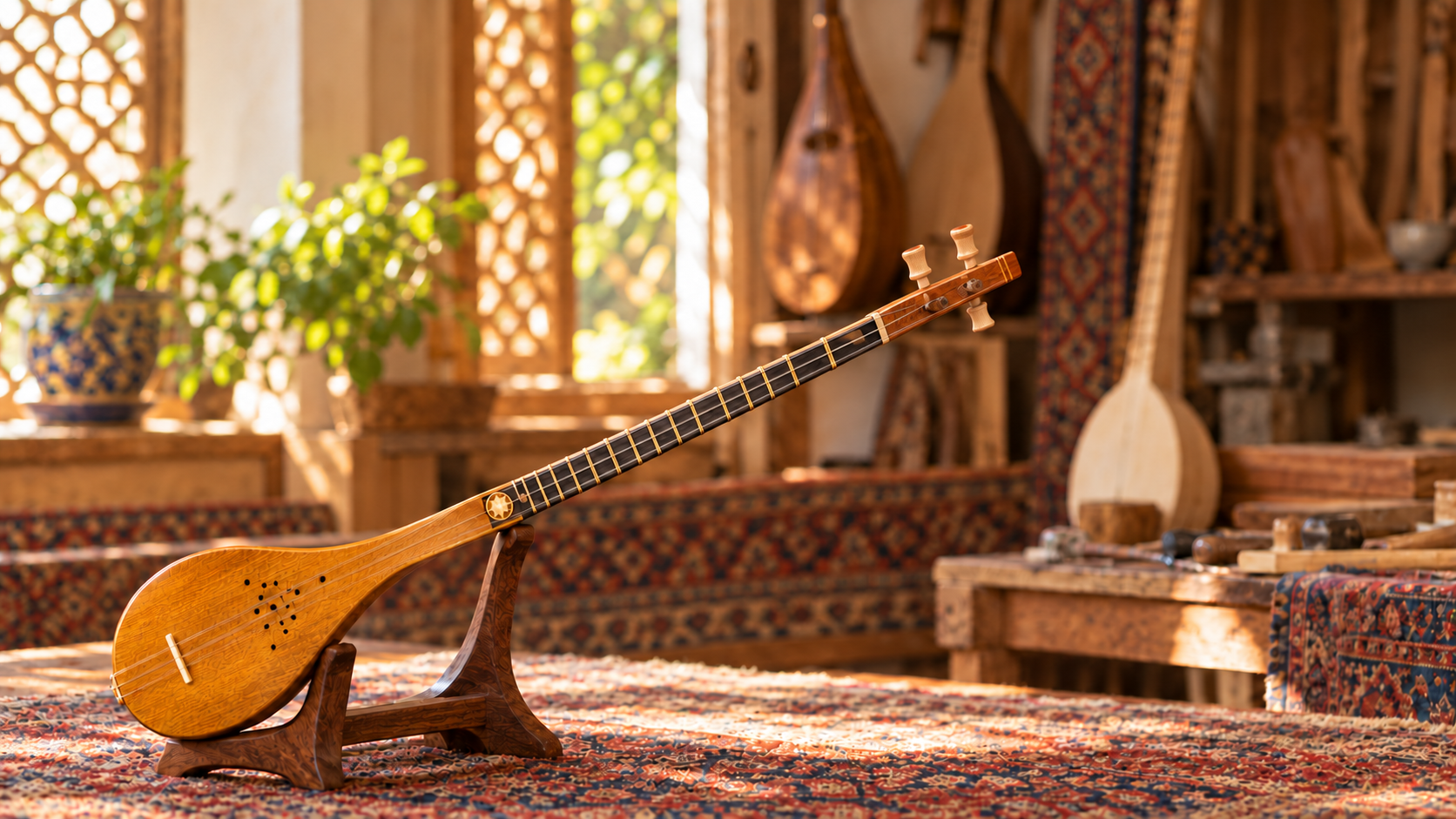
A guitarist can play hundreds of songs without changing the standard tuning of their instrument. For Persian musicians, however, changing the tuning between performances is often an essential part of preparing to play. Instruments such as the Tar and Setar are frequently retuned to suit particular musical modes, compositions, and playing styles.
Persian instrument tuning is closely connected to the Dastgah system, which provides the melodic framework for Persian classical music. Different tunings can change how an instrument resonates, which notes ring freely, and how certain musical phrases are performed.
Understanding these differences reveals why tuning is more than a technical adjustment. It is part of how Persian musicians shape the character and expression of their music.
Understanding Tuning in Persian Classical Music
Tuning determines the pitch of an instrument's open strings. On a stringed instrument, musicians adjust string tension until each string produces the desired note.
In Western classical music, instruments such as violins generally follow a standardized tuning system. The four strings of a violin, for example, are normally tuned to G, D, A, and E.
Persian musical instruments often use a more flexible approach.
The Tar and Setar can be tuned in several different ways, depending on the Dastgah being performed, the preferred tonal centre, and the musician's interpretation.
This flexibility reflects the structure of Persian classical music itself.
Unlike music built primarily around major and minor scales, Persian classical music uses a sophisticated modal system that organizes melodies through characteristic intervals, melodic movements, and relationships between important notes.
To understand these relationships, it helps to explore Understanding Dastgah in Persian Music, which explains how the modal system influences traditional Persian compositions.
What Changes When an Instrument Is Retuned?
Changing the tuning affects more than the pitch of individual strings.
It can influence:
-
Which notes can be played without pressing a string against a fret.
-
The resonance created between different strings.
-
The ease of performing particular melodic phrases.
-
The relationship between melody notes and sustained accompanying tones.
-
The instrument's overall response during a performance.
For instance, when two strings are tuned to notes that complement the main melody, they can create sympathetic resonance as the musician plays.
Even strings that are not being directly plucked may vibrate slightly in response to certain frequencies.
This interaction helps produce the layered sound associated with many Persian stringed instruments.
How the Dastgah System Influences Tuning
The Dastgah system is central to Persian classical music.
It consists of seven principal Dastgahs and five related Avaz systems. Each establishes a musical environment with distinctive melodic characteristics.
Among the principal Dastgahs are Shur, Mahur, Homayun, Segah, Chahargah, Nava, and Rast-Panjgah.
Although these systems involve recognizable pitch relationships, a Dastgah is more than a scale.
It also includes characteristic melodic patterns, important resting notes, tonal emphasis, and traditional approaches to developing a performance.
This is why the different types of Persian traditional music cannot be understood simply by comparing their scales with Western major and minor keys.
Why Certain Dastgahs Benefit From Different Tunings
Every Dastgah places particular importance on certain notes.
Musicians may adjust the tuning of their open strings to support those notes and make particular melodic passages more natural to perform.
For example, a musician performing in Shur might select a tuning that reinforces the chosen tonal centre and provides useful open-string resonance.
A performance in Mahur could benefit from a different arrangement of open-string pitches, depending on the composition and musical register.
However, it is important to understand that each Dastgah does not have one universal, mandatory tuning.
Different performers may choose different tunings for the same Dastgah.
The choice depends on the instrument, the particular Gusheh or composition, and the musician's artistic preferences.
The Relationship Between Dastgah and Radif
The Radif is a traditional repertoire of melodic material that forms an important foundation of Persian classical music.
It contains numerous melodic units known as Gushehs, organized within the Dastgah and Avaz systems.
Students traditionally learn these melodic patterns through careful listening, repetition, and instruction.
As they progress, they develop an understanding of how melodic phrases interact with the tuning and physical characteristics of their instruments.
The connection between instrument technique and the art of improvisation in Persian Radif music becomes particularly important as musicians begin developing their own interpretations.
A well-chosen tuning can support these interpretations by emphasizing important notes and allowing melodies to flow naturally.
Why Tar Players Change Their Tuning
The Persian Tar is a long-necked instrument with a distinctive double-bowl body and a skin-covered resonating surface.
It typically features six strings arranged in three pairs, or courses.
The strings are plucked using a small plectrum called a Mezrab.
Because the Tar has several courses of strings, musicians can create different combinations of pitches and resonances by changing their tuning.
Open Strings and Resonance
Open strings play an important role in the Tar's sound.
When a musician plucks one course, other strings may respond sympathetically if their tuning corresponds to frequencies present in the played note.
This creates additional resonance and contributes to the instrument's characteristic tonal depth.
Changing the tuning can alter which notes produce the strongest sympathetic response.
Musicians can therefore select tunings that complement the tonal relationships of the music they intend to perform.
The physical construction of the instrument also contributes to this effect. In particular, why the Persian Tar uses a skin soundboard helps explain its distinctive acoustic response compared with instruments that use wooden soundboards.
Tuning and Playing Technique
Different tunings can also change the physical demands of a musical passage.
A melody that requires frequent changes in left-hand position under one tuning may become more comfortable under another.
Likewise, a musician may use an open string to sustain a note while playing a moving melody on another course.
This technique can create a continuous tonal foundation without requiring a second instrument.
Musicians learning how to play Persian music with the Tar eventually discover that choosing an appropriate tuning can make certain passages more expressive and technically manageable.
Why Setar Players Use Different Tunings
The Setar is closely related to the Tar in its musical tradition, but its construction and playing technique are different.
A modern Persian Setar typically has four strings, including two strings that are commonly tuned to the same pitch and can contribute to a combined resonant response.
Unlike the Tar, which is played using a separate plectrum, the Setar is traditionally plucked with the fingernail.
Its quieter sound makes subtle changes in resonance especially noticeable.
The Importance of Open-String Relationships
Setar players frequently choose tunings that support the tonal centre of a composition.
The relationships between open strings can make some notes feel more stable, emphasize particular melodic intervals, or create a sustained background resonance.
For example, a commonly taught tuning arrangement uses the pitches C, G, C, and G, although this is only one of several possibilities.
Other arrangements are selected for different musical requirements.
The exact sounding pitches may also vary depending on the musician's reference pitch and instrument.
Learning how to tune a Setar correctly provides a useful starting point before experimenting with more specialized arrangements.
Why Tuning Matters for Solo Performances
The Setar is particularly well suited to intimate solo performances.
Because the instrument has a relatively delicate sound, small changes in resonance can significantly influence the listener's experience.
A carefully selected tuning may allow important notes to ring longer or create stronger relationships between melody and accompanying open strings.
This becomes especially valuable when performing slow melodic passages in which individual notes are given time to resonate.
The Setar's expressive possibilities also depend on accurate fret placement, controlled plucking technique, and the musician's ability to shape each phrase.
The Role of Movable Frets in Persian Instrument Tuning
An important distinction must be made between tuning an instrument's strings and adjusting its frets.
These are related, but separate, aspects of instrument preparation.
The Tar and Setar traditionally use movable frets tied around the neck.
Unlike the fixed metal frets of a conventional guitar, these frets can be adjusted to accommodate different interval requirements.
Why Fixed Western Frets Are Different
Most modern guitars use twelve-tone equal temperament.
This system divides the octave into twelve equal semitones.
Persian classical music, however, uses pitch relationships that do not always correspond precisely to those equal-tempered intervals.
Movable frets allow players and instrument makers to establish positions appropriate to the musical tradition.
They also offer flexibility when a performer needs to refine certain intervals.
The subject is examined in greater detail in why Persian instruments use movable frets instead of fixed frets.
Are Persian Intervals Always Quarter Tones?
Persian music is frequently described as using quarter tones, but this explanation can be misleading.
Although some intervals approximate the size of a quarter tone, traditional Persian intonation is not simply a system of twenty-four equally spaced notes.
Actual pitch relationships depend on the musical mode, melodic context, performance tradition, and the musician's interpretation.
Experienced musicians learn to recognize these distinctions through listening and practical experience.
Consequently, adjusting frets and changing open-string tuning serve different purposes.
Frets help establish available stopped pitches, while open-string tuning changes the instrument's resonant foundation and technical possibilities.
Do All Persian Instruments Require Different Tunings?
Not every traditional Persian instrument uses tuning flexibility in the same way.
The construction of each instrument determines which adjustments are practical.
Santur
The Santur is a hammered string instrument featuring groups of strings stretched across a trapezoidal wooden soundboard.
Its strings are struck using two lightweight mallets.
The instrument requires numerous tuning adjustments because different string groups must produce the pitches needed for the chosen musical material.
Retuning a Santur can be more time-consuming than adjusting a Tar or Setar because of the number of strings involved.
Some changes in musical mode may be accommodated through playing technique, while others require changes to the tuning of specific string groups.
The arrangement of strings and bridges makes the Santur's role in Persian classical music particularly interesting from both a musical and mechanical perspective.
Kamancheh
The Kamancheh is a traditional bowed instrument that commonly has four strings.
Its tuning can vary according to repertoire and performance practice.
Unlike the fretted Tar and Setar, the Kamancheh has no frets.
This allows the musician to control pitch continuously through finger placement.
Consequently, the player can produce expressive intervals without repositioning frets.
Nevertheless, open-string tuning remains important because it influences resonance and the physical relationship between notes.
Ney
The Persian Ney is an end-blown reed flute rather than a stringed instrument.
Its basic pitch range depends on the instrument's dimensions.
Musicians generally do not retune it by adjusting strings or movable components.
Instead, performers use instruments of different lengths, together with breath control, embouchure, and fingering techniques, to work within different pitch ranges and musical contexts.
This demonstrates how Persian musical traditions accommodate modal flexibility through several different approaches.
How Musicians Choose the Right Tuning
Selecting a tuning is not always a matter of following a chart.
Experienced musicians consider several practical and musical factors.
1. The Dastgah or Composition
The most obvious consideration is the musical material.
A particular composition may benefit from open strings that emphasize its important notes.
2. The Instrument's Natural Response
Two instruments of the same type do not necessarily respond identically.
Differences in construction, string tension, setup, and resonance can influence the player's preferences.
3. Playing Technique
Some tunings make particular finger movements or melodic combinations easier.
This is especially relevant when a piece includes repeated pedal notes, sustained tones, or rapid changes between strings.
4. The Musician's Preferred Register
Singers and instrumentalists sometimes choose different tonal centres to suit their comfortable range.
The same musical material may therefore be performed at different absolute pitches.
5. Ensemble Requirements
When musicians perform together, their instruments must accommodate compatible pitch relationships.
A tuning that works beautifully for an unaccompanied Setar performance may need adjustment when playing alongside other instruments.
Common Mistakes When Experimenting With Persian Tunings
Musicians who are new to alternate tunings should approach the process carefully.
One common mistake is increasing string tension too quickly.
Every string is designed to operate within a practical range of tension. Tightening beyond that range can increase the risk of breakage or place unnecessary stress on the instrument.
Another mistake is assuming that a tuning demonstrated by one performer is universally correct.
Traditional Persian music allows different interpretations, and tuning preferences may vary between teachers and musical schools.
Beginners should also avoid moving tied frets without understanding the intended interval positions.
Incorrect fret placement can make an instrument sound inaccurate even when its open strings are correctly tuned.
Finally, string condition matters.
Old, damaged, or unsuitable strings may struggle to maintain stable tuning.
Understanding the importance of Persian instrument accessories and replacement strings can help musicians maintain a more reliable instrument setup.
Choosing a Tuning That Serves the Music
The purpose of Persian instrument tuning is not simply to make an instrument sound higher or lower.
Different tunings allow musicians to support important melodic notes, strengthen resonance, simplify certain playing techniques, and interpret traditional compositions more naturally.
The relationship between tuning and Dastgah is particularly important because Persian classical music emphasizes melodic identity and expression alongside pitch accuracy.
For beginners, learning one reliable tuning provides a foundation for developing listening and playing skills.
As musicians become more familiar with the Radif and different Dastgahs, alternative tunings become another means of shaping their performances.
At Rhythm Music Shop, musicians can explore traditional Persian instruments, strings, accessories, and educational materials suited to different experience levels. Visit our Markham store to discover instruments and resources that support your study of Persian music.